


Welcome to another edition of Willoughby Hills!
This newsletter explores topics like history, culture, work, urbanism, transportation, travel, agriculture, self-sufficiency, and more.
In the last decade or so, we’ve all had some version of this experience: you say something out loud, or you pass something in a store, or you realize you’re low on a certain item and suddenly, like it was reading your mind, there’s that item in front of you on a screen.
It might be a sponsored post on a social media platform or a banner ad on a website you’re visiting. It’s an eerie feeling, violating in some ways. It’s like the machines in your life were listening and they used that data to target you.
But what happens when that targeting happens without any digital trace? When the algorithm pulls something so deep from your subconscious that it couldn’t have recognized without somehow implanting itself into your hippocampus itself.
That happened to me recently when browsing Facebook Marketplace.
There, unexpectedly, was my grandfather’s garden cart. One I haven’t seen or thought about since my childhood.
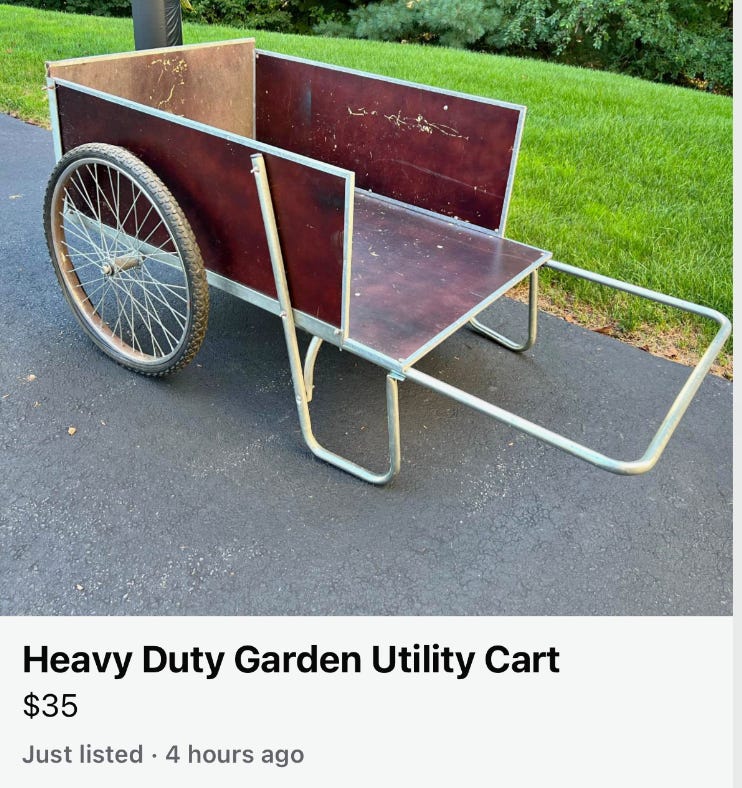
I mean it wasn’t his. At least I don’t think. I assume it’s one that looks like his, manufactured by the same people around the same time.
There’s a few things that you should know about why this was so odd for me.
My grandfather was an avid gardener. When he died 14 years ago, I brought a few of his garden tools to my house: a digging shovel, a transplant spade, a metal rake. They were all really high quality and I use them in my yard to this day because it helps me to feel connected to him. They’re also really well built and better than anything at the big box stores today.
For the last maybe 10 years of his life though, my grandfather’s physical activity was pretty diminished. He still loved to see his perennials come back and flower year after year, but he wasn’t able to get out in the garden and weed, transplant, or prune like he used to. So for all intents and purposes, it has been probably 25 years since that garden cart has even been used, discussed, or thought about in any meaningful way.
To my knowledge, there’s no digital fingerprints of that garden cart that exist. Any photos that were taken of it were 35mm prints, developed locally decades ago. I took a picture of those photos just now for this article, but they’ve never existed digitally until a few moments ago.
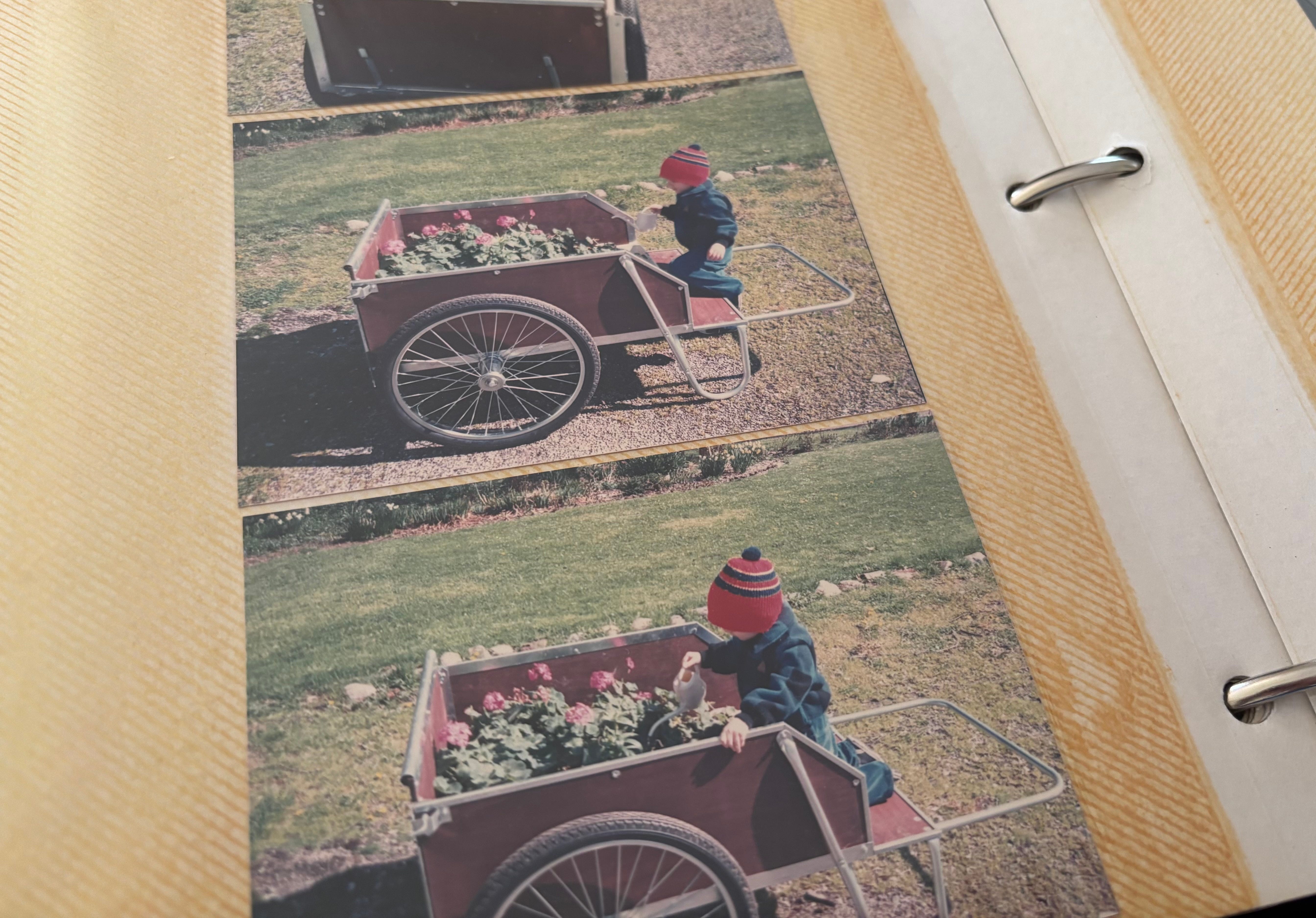
I can’t remember any experiences related to that cart which might have involved some kind of a digital component- maybe gardening with my grandfather with a smartphone in my pocket that was listening to our conversation or photographing it with a digital camera. This was so long ago that the technology simply didn’t exist.
Another important note is that I don’t have an active Facebook profile. When I want to buy or sell items on Marketplace, my wife allows me to use her account. She’s also not actively posting or consuming Facebook content, but she has an active account that she uses primarily for direct messaging friends and family that are only on that platform.
I mention this because I think it’s an interesting distinction. Our Marketplace algorithm is a mix of what I’ve searched for in the past and what my wife has searched for as opposed to a pure picture of either of our individual tastes. Meta may think they have a psychographic profile of her, but it’s muddled with my own preferences as well. It’s more of a hybrid than anything else.
So how did Facebook know, or at least guess, that I might be interested in a vintage garden cart? Or if not interested in purchasing it, know that I might want to at least see one again after all these years?
I have two possible hypotheses. The first is that this was a coincidence. That Meta knows that I from time to time search for specialty tools and that sometimes these include garden equipment. It didn’t mean to dredge up any specific memory. It was complete serendipity and nothing more.
The other guess is that Meta has been amassing mass amounts of data on its users for years. It may not know when I was born since the profile isn’t mine, but it knows when my wife was born (and she and I are only a few months apart). It knows where she went to high school, where she went to college, and who were friends were at those various life stages. It probably thinks it knows her better than I do, and we’ve been married for 16 years.
I wouldn’t be surprised if it can use that data to narrow down that which might invoke nostalgia for us and all of the users of the platform. There was a viral quiz in the New York Times many years ago that could identify with surprising specificity where somebody grew up based on a few questions about region-specific language they use.
I wonder if there’s something similar happening at Meta. That they know that this particular garden cart was popular during a certain era, maybe even in parts of the country or with people that have certain interests. Maybe not. Maybe it was all just a weird coincidence.
But even if it was a coincidence in this instance, it doesn’t mean it’s not tracking and that sometimes these things actually happen with intention.
At any rate, the whole experience just made me feel exploited. A private memory that only existed in my very human brain and pressed between plastic sheets in a physical photo album was suddenly, somehow, fair game for data mining for the purposes of marketing.
Then it hit me.
I might be the last of a generation to understand that feeling of violation. To have something that I thought was mine suddenly belong to the internet.
Because my children don’t live in the same world that I was born into. They are constantly being tracked, surveilled, and having cookies collected on them.
There is not a single photo that exists of either of my children that wasn’t either taken with a smartphone or taken with a digital camera and then later added to an internet connected device like a computer or smartphone. Every photo I’ve taken in the last 22 years sits in my digital photo library.
My kids don’t have a private photo album that can only be viewed in our living room. In order to get prints made of their childhood, I have to upload digital files to Shutterfly. Every single memory exists in some cloud somewhere, which means at least in theory, anybody (or any algorithm) can use it to exploit them.
They don’t know a world of riding bikes with friends around the neighborhood, exploring, getting lost, getting into a little trouble. They are tracked with phones and wristwatches. Even if they don’t personally own these devices, their friends do. Or we do.
They are seen on Ring doorbell cameras on every neighbor’s front porch, tracked door to door to door. Their movements are picked up by Flock cameras and analyzed by a giant police database. Every restaurant, every gas station, every city bus is covered in cameras. They can’t go anywhere or do anything undetected.
Target has admitted that they have bluetooth beacons in their overhead lighting and they have been using that technology to track shoppers using their phones for more than a decade. Even those who opt to not carry a smartphone are now being tracked, as there are bluetooth transmitters being added to shopping baskets and carts.
BJ’s Wholesale Club has robots roaming the aisles (for “inventory reasons.”)
It’s impossible to overstate just how little privacy any of us has any more.
This goes well beyond just marketing and trying to sell me a used garden tool. Why do we need to be under constant surveillance and who benefits from this data? Sure, it’s Meta or Disney or some other big company in the short term.
But it’s also political leaders, authoritarians, police, and militaries.
And that scares me.
I don’t have any easy solution or any tips for how to cope. I only know that our memories, our thoughts, and our ideas no longer belong to us alone. They exist in some other realm now, or they can if we’re not careful to protect that which is ours.
Thanks for reading Willoughby Hills! Subscribe for free to receive new posts and support my work.
Related Reading
If you’ve missed past issues of this newsletter, they are available to read here.
I find it invasive and creepy. And seeing/hearing what's going on with AI and data centers, there is potential for massive nefarious action. I guess like anything else, it has positives and negatives. But I don't know; it seems that lately (meaning, the past decade) things have really gone to the dark side. Very worried. Targeted advertising seems harmless enough. But the underbelly! Thanks for another thought-provoking article, Heath.