


Welcome to another edition of Willoughby Hills!
This newsletter explores topics like history, culture, work, urbanism, transportation, travel, agriculture, self-sufficiency, and more.
Like many people, I am not happy with the relationship that I have with my smart phone.
It’s easier to recognize the problem in other people than to admit it to myself. Sitting in a doctor’s waiting room or on a subway car and realizing that everybody around me is being transported into their own little world. They have no idea what’s actually happening around them, only what’s happening on that glass rectangle in their palm.
But then I find myself just like the others, in the checkout line at the supermarket or sitting at a red light in traffic and instinctively checking. For what, I’m not sure. Why, I’m not sure. It’s often muscle memory and reflex at this point more than a conscious decision.
As I’ve written about before, it’s become way too easy to open an app, scroll, and lose all sense of time. What started as a quick “let me just check in” can easily become 45, 60, 90 minutes in a heartbeat.
But as I’ve also written about, smartphones have become a necessary part of living in this modern era. I mean, not entirely necessary. There are still some workarounds. But they are the most convenient, lightest way to carry payment cards, loyalty cards, a camera, a navigation device, and lots of music and podcasts.
For those reasons, I’m not fully anti-phone. An iPhone or similar device is a modern wonder.
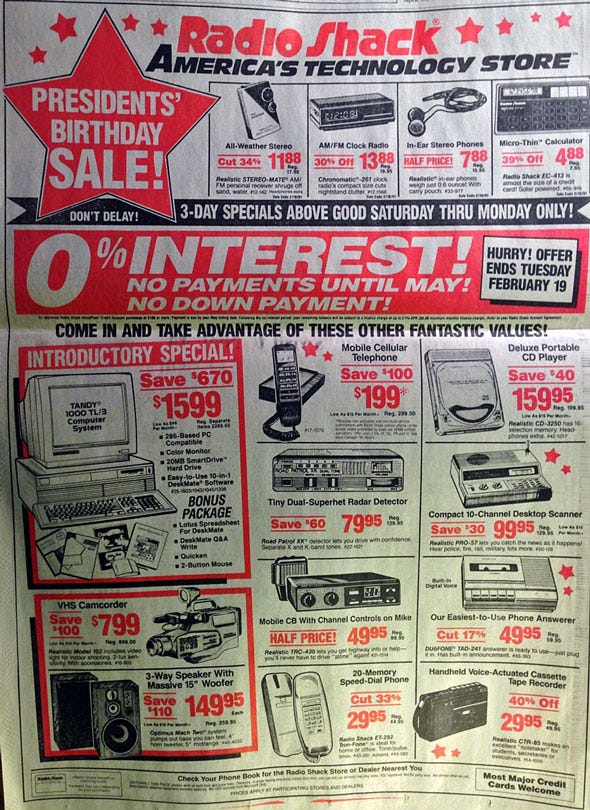
There has been a meme circulating for years on various social platforms which shows a Radio Shack newspaper ad from 1991 advertising lots of different products at various price points, nearly all of which can now be done with a handheld, portable device: phone, answering machine, video camera, calculator, music player, cassette recorder, desktop computer.
It’s not necessarily the device hardware that’s problematic. I doubt having access to a calculator or compass is what’s driving up anybody’s screen time. The issue is really that certain software, like social media apps, are addictive by design.
I’ve been wrestling with how best to manage this for myself for a while. My mind keeps coming back to wanting to buy a “dumb phone,” basically a cell phone that can connect to modern networks but still feels very pre-2007. Something like a flip phone or a basic Nokia that would allow me to make and receive calls and texts, but wouldn’t do much more beyond that.
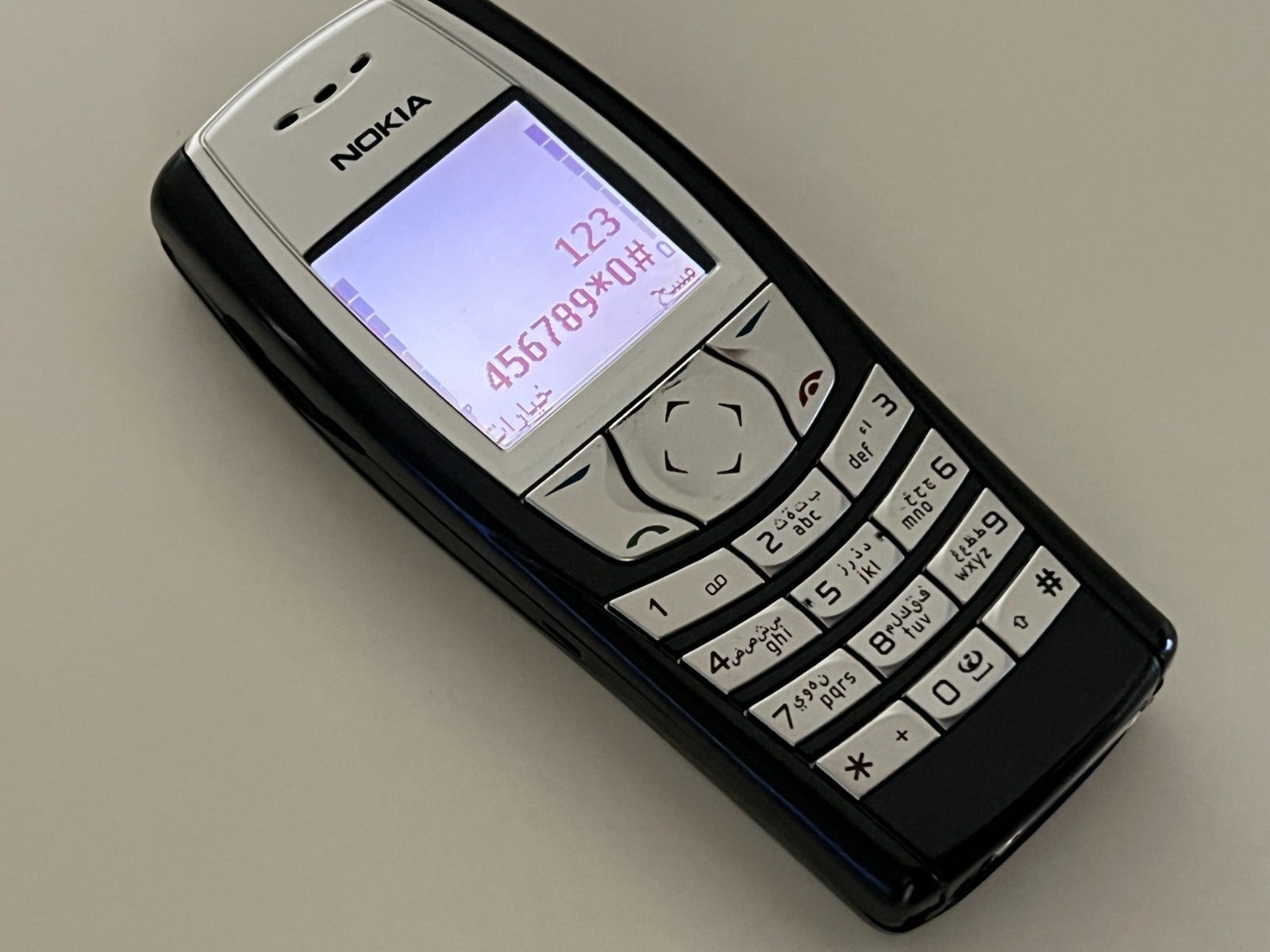
I’m not alone in this. Dumb phones are becoming trendy, not just with people who have memories of actually carrying around a cellphone like this once upon a time, but also with many young people.
This comes with some challenges, of course.
Even a lot of dumb phone users seem to admit that their ability to have a flip phone is dependent upon others in their orbit having a smart phone. Actor and comedian Aziz Ansari, who lives in London, spoke about his relationship with his phone to Amy Poehler on an episode of her podcast last fall:
Ansari: I don’t have email. I haven’t had email for, like, 10 years.
Poehler: Incredible.
Ansari: Yeah. But I have an assistant.
Poehler: Okay. All right. But still.
Ansari: I have a flip phone, and if I get really lost, I gotta either ask people or just call my wife and be like, hey, I don’t know where- I’ve had to do that before. Like, call my wife and be like- And to the point where she’s, like, kind of used to it. You know, I hail taxis, and if there’s not a taxi, sometimes I’ll call and be like, there’s no one around.
Poehler: So you don’t use, like, an Uber app usually?
Ansari: In London, there’s taxis all the time. You can hail them. And here, too. New York.
All you need to make a dumb phone work is have an assistant to receive your emails, a wife to answer your calls and help you navigate, and be in a place where taxis are plentiful and can be hailed with a raised hand. This may work for a very specific subset of the population (wealthy actors living in London or New York maybe), but for the rest of us, it’s impractical.
So while a dumb phone sounds great in theory, the reality of one in 2026 is much harder.
For those reasons, and many others, I’m not in a place where I could fully divest from an iPhone, at least not yet. I rely on it for work related communications, take photos with the camera regularly, and use it as a music and podcast player.
But maybe buying a dumb phone could still help me cut down on screen time. I could keep the dumb phone in my pocket and leave the iPhone slightly further away, like in my car or my backpack.
In doing a bit of research, I learned that a big hurdle to having two phones is requiring two phone numbers. As far as I can tell, there’s no easy way with the U.S. mobile carriers to have one number ring to two cell phones. There are ways to do call forwarding from an iPhone, but that would have to be set up manually each time.
In other words, I would be requiring people in my life to store two numbers for me and be conscious of which number to dial or text in which circumstance. It’s burdensome for everybody else to manage. Or it’s up to me to manually turn on and off the settings every time that I’m away, which feels open to error.
In going down the rabbit hole of understanding having one number ring to multiple devices, I did discover what seemed like a decent work around. I’ve learned that many people are using existing technology to create their own semi-smart phones until Apple (or another major company) invents a pared down phone that can do basic functions but without all the bells and whistles.
There’s an entire cottage industry that’s sprung up on sites like Etsy selling cases to turn an Apple Watch from a wearable into a handheld, essentially an Apple Watch dumb phone.
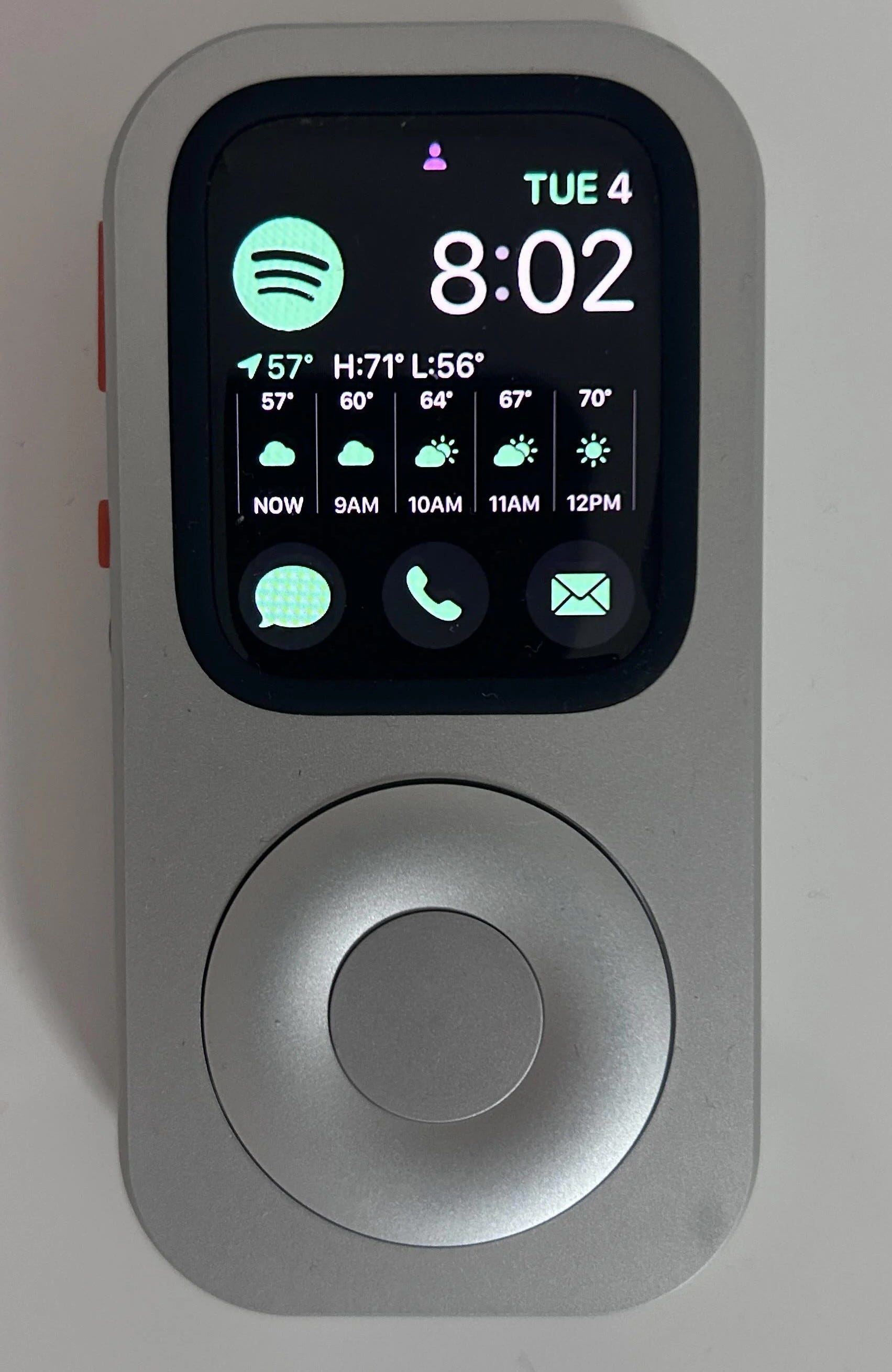
In this case, the Apple Watch is paired to your iPhone for setup, so both devices share a single phone number. An incoming call will ring both places, and they need not be in proximity to one another for this to work.
There are some tradeoffs to this approach. If the watch/phone (wPhone?) is going to work without an iPhone in close proximity, it needs to be a model that supports a cellular connection (and not all of them do). This means an added nominal charge to your monthly mobile bill, usually around $10-15.
The calling functions of the Watch only work in speakerphone or with an attached bluetooth headset. There is no option to have a quiet call near your ear. If I’m making a brief call to my wife in the aisle of the grocery store, this may not be an issue. If I’m answering a sensitive call from my doctor in a library, this is a problem.
There’s also no easy way to input text, so while the “wPhone” will send and receive text messages, it only uses voice dictation to send outgoing messages. Users also complained about battery life because the battery is so much smaller than a conventional phone.
A cellular-rated Apple Watch costs about $500 up front, plus the ongoing charge of roughly $10 per month to connect. A phone case to make the watch handheld can run another $20-50. The price tag can grow quickly.
I considered buying a used watch on somewhere like Marketplace, but even then, they were at least $100. I wasn’t even sure which model was a good investment, as I’m not up on the modern nomenclature. I assume a “Series 7” is better than a “Series 3,” but where does an “SE Series 2” fit in that hierarchy?
In the end, my wife pointed out the idiocy of my thinking. My whole goal was to consume less, yet my method to solving that problem involved buying more stuff. One phone’s a problem? Why not try two phones…
Beyond that, even the time I spent researching how to use a smart phone less was done on a smart phone.
I felt a bit like the Wizard of Oz characters when they meet the wizard at the end of the movie. I didn’t need a brain, I just needed a diploma affirming that I had a brain. My courage wasn’t lacking, it was the lack of a metal declaring my courage.
Here I was seeking an answer to my phone addiction when the answer was really inside of me the whole time: just use the phone I have less.
I was searching for a device that would solve my problems for me, rather than being willing to do the inner work to actually resolve my own dysfunctional relationship with my phone.
After realizing this, I’ve been trying to more deliberate about where I keep my phone. If I’m at home, it’s often on the kitchen counter or in a drawer, rather than in my pocket. If I’m going to check it, I’m going to do it deliberately, rather than to fill the time. In the car, I keep it in a cup holder behind me so that the screen isn’t visible when I’m driving. I’m noticing when that reflex to reach for the phone is happening and trying to retrain my brain on a different action.
I’ve also tried to rely on navigation tools less. I’ll check the map before I leave and get a sense of where my destination is, then try to navigate there using my own memory and thinking skills. I don’t always succeed, and will sometimes use navigation for the “last mile” or in places where I get stuck, but I’d rather that than have turn by turn directions running the whole time, even in places I know well.
This has made me a more present, focused, and observant driver.
91% of American adults now own a smart phone. 43% of tweens (age 8 to 12) and 88-95% of teens (ages 13 to 18) have their own smart phone. Smart phone addiction is only going to get worse.
I once thought a dumb phone could be the solution, but I’m learning, as with any other addiction or problem, the only answer that will stick is the one inside of all of us.
Well, actually, another solution would be for Big Tech to make their products less addicting, but I don’t see that happening any time soon. So for now, the best solution is the only one that’s within our control.
Thanks for reading Willoughby Hills! Subscribe for free to receive new posts and support my work.
Related Reading
If you’ve missed past issues of this newsletter, they are available to read here.
I think you'll enjoy this related essay:
https://www.panoptica.com/i-want-it-but-i-dont-like-it/
We bought a Brick and honestly it’s been a game changer. I tried to curb the habit using my own will power and am ashamed to admit that the Brick is the only thing I’ve found that truly works for me. I spent 114 consecutive days “bricked” from social media this spring. I had hoped the very long break would curb the habit but once I “unbricked” I was back into old habits quickly. I only use it to block social media but you can set up the controls however you like. I recommend it often to others!