


Welcome to another edition of Willoughby Hills!
This newsletter explores topics like history, culture, work, urbanism, transportation, travel, agriculture, self-sufficiency, and more.
Like many Americans, there seems to have always been a desire in me to travel and see new places. Childhood trips were few and far between though, and mostly involved visiting places within driving distance of Northeast Ohio. As a teenager, I had only been on a plane once, to visit California for my uncle’s wedding.
When I got my driver’s license, that desire to get away was stronger, but I didn’t quite have the bank ledger to support a jet setting lifestyle. I used to drive my dad’s station wagon to Cleveland Hopkins Airport, about 40 minutes from where I lived, just to read the departure signs and imagine being someplace else.
When I first was hired at This Old House in 2005, one of the most exciting parts of the job description was the line “extensive U.S. travel.” I would get to see the country without having to pay for it myself.
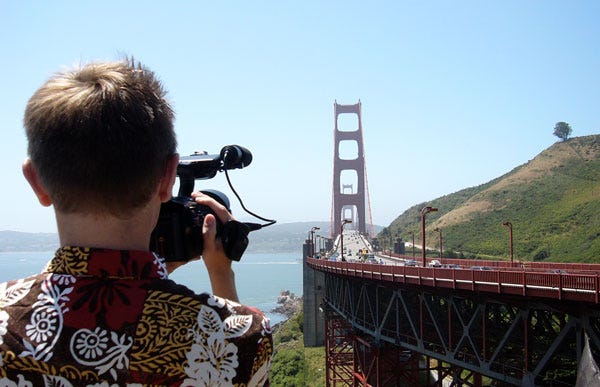
In the early days of my time at This Old House, we would travel a few times per year, almost always to large cities: Dallas, Atlanta, Denver, San Francisco. But I distinctly remember when we started to make a deliberate effort to see more of the U.S., and I can attribute that change to one person: Larry the Cable Guy.
I’ve never met Larry, the stage name of comedian and actor Daniel Whitney, and he had nothing to do with This Old House directly. But he still had a big impact on the show, how we travelled, and how I continue to travel with my family.
When I was a producer at Ask This Old House, I remember receiving a press release in my inbox about some show starring Larry. I don’t recall all of the particulars, but I think it was the type of program that traveled to factories or the workshops of craftspeople and celebrated American ingenuity. I know it was on basic cable, and having worked on some basic cable shows, I knew those budgets were minuscule.
The press release was celebrating the release of a new season of Larry the Cable Guy’s show, perhaps the third or maybe the fourth season. It was a show I hadn’t heard of and that I had never heard anybody mention, but what stood out to me was the line recalling the prior seasons where they made a claim like “visiting all 50 United States.”
I was floored.

Larry the Cable Guy, on a shoestring budget, in less than five seasons, had somehow managed to visit every single state and tell a story in each one. Ask This Old House was probably around season 11 at that point, and by my calculations, we had been to something like 32 states.
There was a strange point of pride at the thought of beating Larry the Cable Guy (or at least catching up to him, as he had already beat us), but there was something deeper that his press release seemed to uncover.
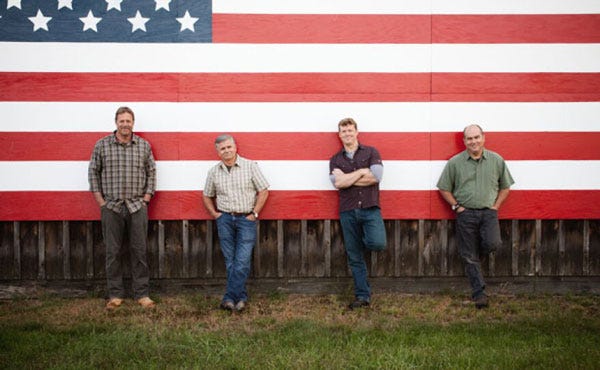
Ask This Old House felt like an “All American” show. Our logo was red, white, and blue. The imagery of the show included a construction trailer towed by a pickup truck traversing interstates and crossing bridges. We took a press photo up against the American flag Patton style one year.
We deliberately tried to feature a diverse cross-section of America: in age, gender, race, socioeconomic status, house style, and geography. And yet, we could never be fully inclusive if we were only showing up in big markets and ignoring some of the less populated or less popular places.
It became my obsession to figure out ways to get us to film stories in all 50 states without breaking the bank. If we had a trip planned to Denver, we could drive 90 minutes north on I-25 and visit Cheyenne, Wyoming, just over the Colorado line.
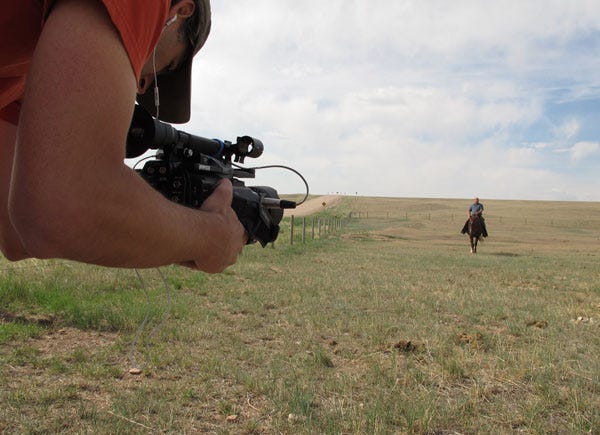
We later took a trip across the Gulf Coast that brought us to Mobile, Alabama; Biloxi, Mississippi (less than an hour away); and New Orleans, Louisiana (90 minutes from Biloxi), all states we had not previously visited.
Another time, stopped in Wheeling, West Virginia as part of visits to Cleveland and Pittsburgh. Wheeling is located on a little wedge of West Virginia smooshed between Ohio and Pennsylvania that’s less than 12 miles wide. If you were driving on I-70 in this stretch of West Virginia and listening to a long rock ballad like “Stairway to Heaven,” there’s a good chance you’d cross the state line before the song ended.
Eventually, we did reach all 50 states with Ask This Old House, and I made sure to include that milestone in every press release I could afterwards. It only took us 15 years to accomplish what Larry the Cable Guy did in three or four, but we eventually made it.
This strange quest to visit every state has been on my mind again after my family purchased a motorhome four years ago. As a kid, one of the coolest parts about passing an RV on the freeway was seeing folks that had a map indicating the states they had visited. I was usually just heading to visit family in states bordering Ohio like Michigan or Indiana, but I liked to imagine what it must be like to drive your entire vacation home to Montana, California, or Arizona.
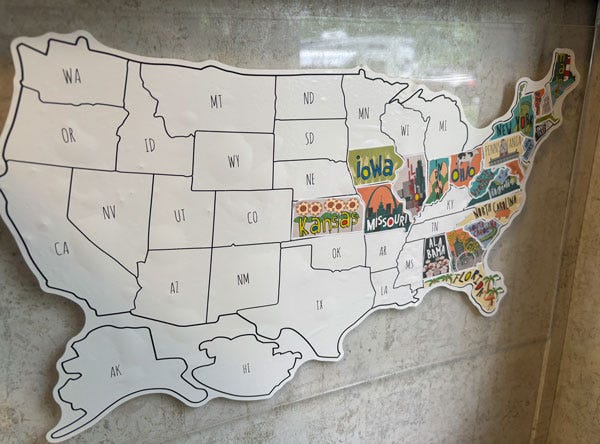
When we purchased our RV, we imagined it would be for local destinations within a few hours of our home in Massachusetts: Cape Cod, Maine, Vermont, places like that. Even with simple travel goals, I still wanted to purchase a sticker map for our RV, mostly because I had admired them as a kid and thought my kids might find similar enjoyment in tracking their travels.
The rules for our map were simple: we had to camp at least one night in a state to earn a sticker (just driving through didn’t count) and nights earned camping in any RV counted towards our total (we had rented an RV and traveled to Maine before purchasing ours, so Maine counted).
Even though we didn’t exactly plan for it at first, we ended up traveling in our RV quite a lot. In fact, over the last four years, we have now accumulated 24 state stickers! It’s hard to believe that we’ve covered almost half of the country at this point.
As we’ve looked to earn stickers for the RV, I’ve fallen back into some of the old patterns that I learned at Ask This Old House. In both cases, it was important to visit somewhere within a particular state, but that doesn’t always mean visiting the most well-known place or having a stereotypical experience.
On our summer trip to Kansas City, Missouri this year, we opted to cross the border into Kansas City, Kansas and spent a night at a Christian retreat that allows Harvest Host overnight campers. We had hoped to visit Topeka or some of the more prairie sections of Kansas, but instead, we were off I-70 not far from an outlet mall and still very much within the gravitational pull of the Kansas City metro.
Our kids can now say they’ve camped in Kansas, but did they really?
On the way home, we also briefly detoured into Burlington, Iowa, which is in the Southeast corner of the state close to both the Missouri and Illinois borders. Our kids didn’t get to see Des Moines, the World’s Largest Truckstop, or whatever people think of as a typical Iowa experience.
Instead, we camped on an elk farm where a retired school teacher raised elk for meat, leather, and to sell to the operators of hunting camps out west. It was a memorable experience, being six feet away from majestic elk at sunset, but was it quintessentially Iowa in any way?
Strangely enough, I think it was.
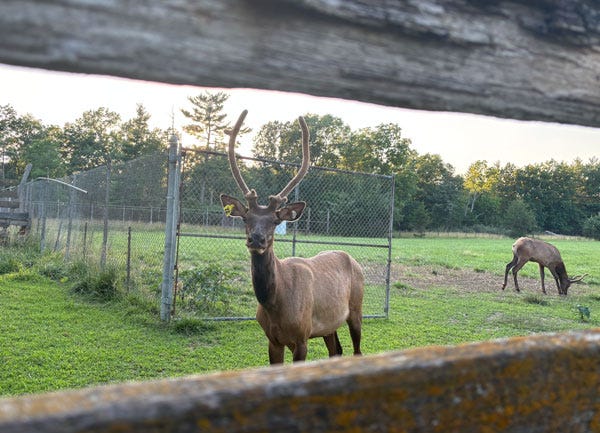
It’s hard to describe, but there is a different feeling crossing a state border. Things look different, things feel different. I’ve made the point before in this newsletter that in a satellite view of North America, no state or national borders are evident. Theoretically, nothing should change when one crosses an invisible line on the earth. And yet, things are different. Even though state lines seem somewhat arbitrary, they somehow aren’t.
The bigger question for me, first as a television producer and now as a father, is if I ever really experienced a place by visiting the strange borderlands, rather than getting into the heart of a place. It would be like claiming California, but only visiting Fresno and never seeing Los Angeles or San Francisco. Or at least I feel that way sometimes.
I was recently reading John Steinbeck’s Travels with Charley: In Search of America, which documents the author’s 1960 cross-country road trip with his poodle. Steinbeck seemed to reassure me that the experience of place is subjective and that there isn’t one singular truth to anywhere in the world:
“On the long journey doubts were often my companions. I've always admired those reporters who can descend on an area, talk to key people, ask key questions, take samplings of opinions, and then set down an orderly report very like a road map. I envy this technique and at the same time do not trust it as a mirror of reality. I feel that there are too many realities. What I set down here is true until someone else passes that way and rearranges the world in his own style. In literary criticism, the critic has no choice but to make over the victim of his attention into something the size and shape of himself.
And in this report I do not fool myself into thinking I am dealing with constants. A long time ago I was in the ancient city of Prague and at the same time Joseph Alsop, the justly famous critic of places and events, was there. He talked to informed people, officials, ambassadors; he read reports, even the fine print and figures, while I in my slipshod manner roved about with actors, gypsies, vagabonds. Joe and I flew home to America in the same plane, and on the way he told me about Prague, and his Prague had no relation to the city I had seen and heard. It just wasn't the same place, and yet each of us was honest, neither one a liar, both pretty good observers by any standard, and we brought home two cities, two truths. For this reason I cannot commend this account as an America that you will find. So much there is to see, but our morning eyes describe a different world than do our afternoon eyes, and surely our wearied evening eyes can report only a weary evening world.”
When our RV unexpectedly broke down in Indiana over the summer, we ended up spending more time in the state than anywhere else on our journey. In fact, it may have been the longest stretch I had ever been in Indiana in my life.
My aunt had lived in Richmond for all of my life, which is the first exit in Indiana over the Ohio border, and I had visited her many times. I had another aunt that lived in South Bend for a while when I was a kid. I remember going to her house once, but the bigger pull of that trip was a day trip to Chicago. I had filmed in Indianapolis before, but those trips were only two or three days in length.
This summer, to help speed along our RV repair, I ended up driving from Elkhart to Warsaw, a section of the state inaccessible by interstate. I found myself on the backroads of Indiana, paralleling a train track. There were the occasional signs of civilization that crop up anywhere in the U.S.: Walmart, Chic-Fil-A, Panera Bread. But there was also a different feeling. Dare I say, an Indiana feeling.
In all of my trips to Indiana over the years, had I ever really seen the state? On my drive, I realized that I had probably spent more mental time in the fictional Pawnee, Indiana of Parks and Recreation than in the actual state of Indiana. As any fan of that show knows, nearly all of it was shot in California. “Pawnee City Hall” is actually in Downtown Pasadena. Aside from a few shots in Indianapolis over the years, almost nothing about it is actually “Indiana” other than the fictional setting.
As I approached the city of Goshen, Indiana on my drive to Warsaw, I was considering what the true Indiana really was: my visits to Richmond over the years, the city of Indianapolis, the fictional Pawnee, or the very real “heartland” where I found myself.
As I rounded the corner with this question in my mind, my jaw dropped. There, right in front of me, was Pawnee City Hall! Or Pasadena City Hall. Or actually the Elkhart County Courthouse, which isn’t an exact doppelgänger for Pasadena, but is strikingly similar in the sense that I began to question whether I had in fact ended up in the fictional Pawnee somewhere.
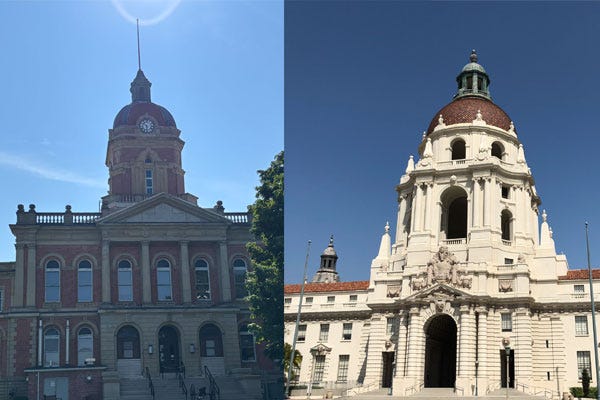
All of these experiences of Indiana seem to be true. The heartland, the urban, the rural. The fictional that takes inspiration from real life and the real life that resembles the constructed reality. I was seeing Indiana, the fact and the fiction merging into one coherent picture. It was all real, and yet, none of it was. How could I say I had visited Indiana when I was also visiting Pasadena and Southern California at the same time? Was this version of Indiana any different than neighboring Ohio or Illinois? Did it matter?
Keeping track of travels with a map, whether for a national TV show or family road trips, are good motivators to get out and see new sights. In all likelihood, had we not decorated our RV with a state map four years ago, we would have been hesitant to venture beyond a 200 mile radius of our home.
My kids visit to Kansas will be memorable for them and they will still be able to tell tales of Kansas, even if they missed the prairie or the cattle ranches. Our visit to West Virginia a few years ago was very insightful for me, even though we were maybe 40 minutes from the Virginia border.
I can now say that I’ve been to all 50 states and that my kids are well on their way to that goal. And it’s all thanks to some basic cable series from decades ago with Larry the Cable Guy.
Thanks for reading Willoughby Hills! Subscribe for free to receive new posts and support my work.
Related Reading
An Unexpected Detour to Elkhart, IN
Did I Have West Virginia Wrong?
If you’ve missed past issues of this newsletter, they are available to read here.
Have you been to Silver Dollar City or Dollywood?