

Welcome to another edition of Willoughby Hills!
This newsletter explores topics like history, culture, work, urbanism, transportation, travel, agriculture, self-sufficiency, and more.
I’ve been thinking about time a lot lately.
Not long ago, I was talking to a retired teacher, who commented to me that her concept of time has completely shifted since she left her profession. She doesn’t even wear a wrist watch anymore. Her days are full, but she is less driven by hourly demands and is more focused on the impact she is having.
She is still active in the school community where she worked for almost forty years, serving as a mentor to younger teachers and occasionally filling in gaps in subject areas. She also volunteers with political groups and does lots of other important work in the community.
And she couldn’t tell you if it was noon or one thirty in the afternoon. She knows what needs to get done and she just does it. When she’s tired, she sleeps. When she has energy, she works.
Can you imagine life without a watch? Without time commitments on the fifteens?
A few weeks ago, I spent an afternoon at Old Sturbridge Village, a living history museum that recreates life in an 1830s era New England town. I’ve visited there many times before, including describing maple syrup production at the Village in this newsletter a few years ago.
The museum campus covers 240 acres and includes more than 40 historical buildings that have been moved, restored, and are now inhabited by costumed interpreters that explain what life was like in Massachusetts 200 years ago. There’s a general store, a bank, a meeting house, a farmhouse, a saw mill, and a blacksmith shop.
On the day I visited, a young man was working in one of the barns, chickens scampering around his feet. He was seated on a shave horse, which is a wooden seat that includes a foot powered vice, and he was using a large draw knife to slowly shape a tree branch into an axe handle.
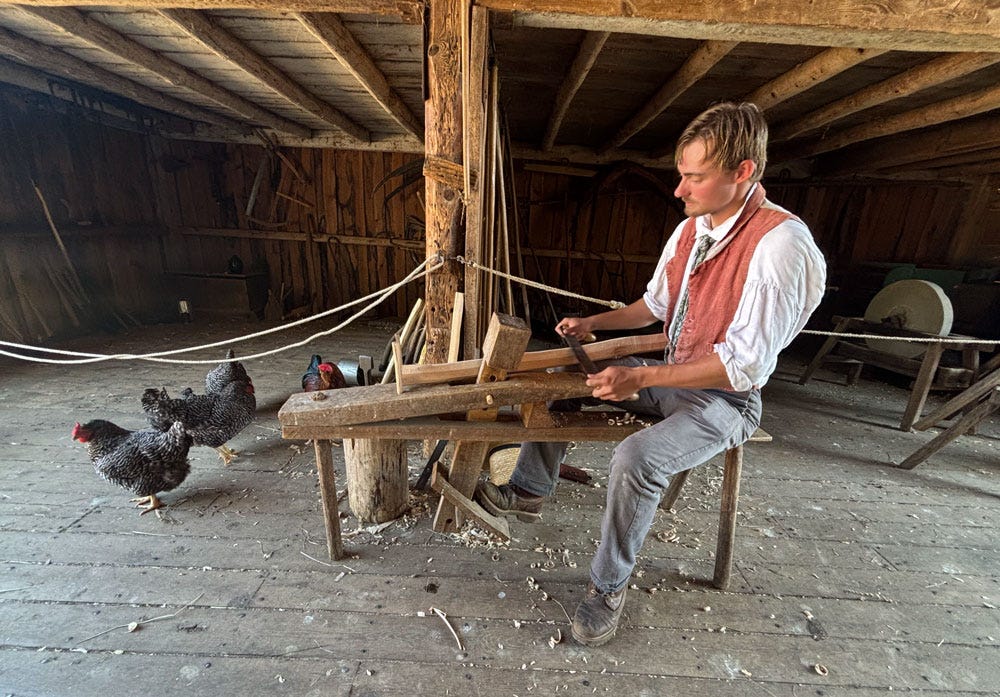
It was a laborious task. While he was aided by some tools, the majority of the work was being done by his own muscles and sweat, not an electric motor. It was tiring and time consuming work. I commented on the elaborate nature of his wooden shave horse.
He told me that while cast iron vices were available to hold wood by the 1830s, they were heavy and expensive. It was much more practical for early Americans to build a shave horse out of wood, which was abundant, and then use that shave horse to build other tools.
“These people didn’t have a lot of money,” he told me. “But what they did have was time.”
Time to sit and focus. Time to work hard at a singular task. Time to build something that will last for a long time.
What do we have time for these days? I would guess the majority of modern Americans have scarcely built even one thing that’s useful. We’ve forgotten how to make. We’ve forgotten how to sew or knit. We barely know how to cook our own food, let alone grow it or plant it or butcher it.
Unlike those 1830 New Englanders, we have the money now. We work hard for the money. And then we use that money to have other people, or sometimes just machines, do the things for us that we used to be able to do.
Buy it now. Have it delivered within the hour. Throw it away. Repeat.
We’ve traded our time for money.
Did we make the wrong deal?
In the dark days of COVID, when we were all cooped up in our houses, my dad’s side of the family began scheduling weekly Zoom calls. My dad is one of twelve kids (eleven are still living) and calls were open not only to his siblings (my aunts and uncles) but also to my generation of 20 or so cousins.
I used to love attending those calls, to hear from my aunts, uncles, and cousins in a regular cadence. It wasn’t just quick small talk at weddings and funerals; we had an opportunity to really hear from each other in deep ways, especially since we were scattered all across the country.
There was a period where several of my relatives were all retiring within a few months of one another, and I remember on one call, they were talking about how they were filling their days.
Each relative seemed to have a similar story: they were finding some way to volunteer their time to help others. Some were working with older people. Others were helping at food banks or soup kitchens. But each one had found meaning and purpose in a way that seemed to really be doing good.
My dad was part of that retirement cohort, and he has spent the last several years now since he left the corporate world volunteering at a local thrift store. The shop is part of the outreach efforts of a group working on transitional housing and fighting homelessness in their community.
My dad’s role at the shop is to go through the donations to the home and garden department. He tests the tools and appliances that come in, sometimes doing minor repairs or cleaning of the items before they are placed on the sales floor.
I visited his thrift store last year and was blown away by the operation. His shop is inside of what looks like an old supermarket, which is quite a large footprint. There are a handful of paid employees, but most of the people running the shop are volunteers.
There’s of course a vast selection of clothing, but also housewares, books, furniture, toys, sporting goods, electronics, tools, and so much more. All of it has been inspected by a volunteer like my dad to be in good condition. Unlike many for-profit thrift stores these days (think places like Savers), the prices are quite low.
Essentially, this thrift store is doing good in a three-fold manner: It’s allowing people the option to donate older items for reuse, rather than dooming them to the landfill. It’s giving other people who may not have a ton of disposable income an option to purchase good quality items at a low price. And it’s using the money earned by selling those items to support the broader mission of ending homelessness and providing housing to those in need.
And it’s being done with volunteer labor, mainly of retired people.
Thinking back to that Zoom call with my family, that story seemed to be replicating itself over and over again with my relatives. Stop working, start contributing to the community.
Which made me question our system. Why must we wait until we turn 65 to start contributing?
The simple answer is economics. Young people have rent or mortgages, health care costs, and all kinds of other bills to pay.
We save for retirement and plan for what we’ll do when we have the time, when we no longer need a wrist watch, not even knowing whether we will live long enough to see that realized.
Wouldn’t it be nice if we could find a way to give thirty-somethings, forty-somethings, fifty-somethings the same opportunity to make the world a better place? To do things bigger than just work, to make a difference in our communities.
It would take some investments: a universal health care system that’s not tied to employment in any way. Some ability to provide for daily needs without needing to give over ever waking hour to some corporate entity for sustenance. A universal basic income, perhaps, that would ensure at least some needs are met for all people.
Just imagine what we would do with that time.
We were there once. As that interpreter at Old Sturbridge Village said, they had time. But that was 200 years ago.
The way our modern world is structured, it’s harder to find that time. It’s harder to make, harder to help. At least before age 65 or so.
My dad and his siblings have continued to tradition of the weekly Zoom call for more than six years now. There’s a group of regulars who log on every week. There’s rarely anybody of my generation on the calls. I haven’t joined one in probably three years. Not because I don’t want to. I miss them dearly. I miss seeing my family regularly. But I just don’t have time.
Maybe in another 25 years. Until then…
Thanks for reading Willoughby Hills! Subscribe for free to receive new posts and support my work.
Related Reading
If you’ve missed past issues of this newsletter, they are available to read here.