


Welcome to another edition of Willoughby Hills!
This newsletter explores topics like history, culture, work, urbanism, transportation, travel, agriculture, self-sufficiency, and more.
There’s perhaps nothing more indicative of achieving the American Dream than having a backyard swimming pool. The Beverly Hillbillies theme song mentions pools. Dustin Hoffman lounges by his pool in The Graduate. Daddy Warbucks has an indoor pool in his mansion in Annie (his mansion actually being part of the campus of Monmouth University in New Jersey).
When we moved to our new house in Western Massachusetts a year ago, I achieved the American Dream, at least on paper. Our house included an in-ground swimming pool.
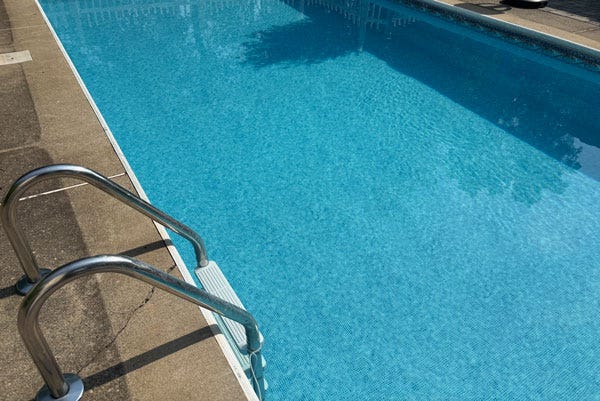
A pool was never on our list of required amenities, but when we began looking at houses, it seemed that most of them included some kind of pool. Perhaps that was more a function of the neighborhoods or price point we were looking in, but at any rate, three of the four houses we considered all had pools.
I’ll admit, there’s definitely something wonderful about taking about 10 steps out my back door on a hot summer day and cooling off in the water with just my family around me. It’s a luxury and a privilege.
But it’s also a lot of work and has come with a steep learning curve.
We have achieved just enough American Dream to own a house with a pool, but not enough that we can pay somebody to maintain it full time. So, like with a lot of things related to homeownership, I have become the default pool boy.
When the pool is crystal clear, it’s wonderful, but out of nowhere, it can sometimes start to get cloudy or even slightly green.
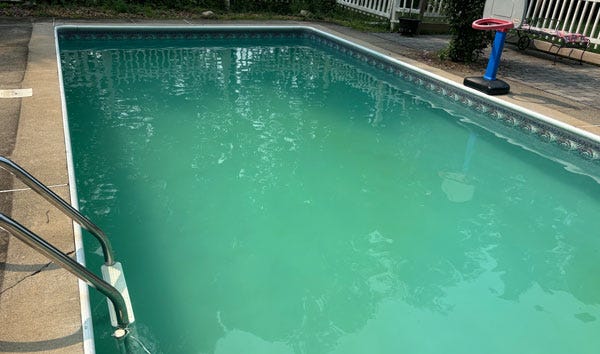
I’ve learned that pools need a constant stream of chlorine to stay clean and clear, but that chlorine is only effective when the pH and alkalinity of the water is in the right range. Heavy rains actually make the pool water more acidic, so after periods of rain, the water needs treatment (usually baking soda).
There’s a filter cartridge that requires cleaning every few weeks. There’s also a pool pump that needs to be manually turned on and off each day (though I’ve been looking at options to automate this). If the pump doesn’t run enough, it can lead to algae growth. But running it all the time can get expensive.
The pool surface needs to be constantly skimmed to remove leaves and other debris that get into the water. If those items aren’t removed when they are floating, they end up getting waterlogged and sink to the bottom, where they can promote algae growth.
I also didn’t know until I owned one that a pool is a magnet for all kinds of wildlife, who love to enter the pool but then struggle to get out. I’ve had to fish out 16 dead mammals so far this year (mostly mice and chipmunks, but also one bat). There have also been dozens of small frogs that get collected in our pool skimmer and hundreds, possibly thousands, of insects of all sizes and species. It’s gross.
I pay a pool company a couple hundred dollars at the beginning and end of the season to open and close the pool. This involves installing or removing a pool cover, draining down the system, plugging the pump ports, and disassembling some of the plumbing components. With some practice, I might be able to do this on my own, but then it’s just more time and labor of mine that I have to invest. The chemicals needed to keep the water sparkling are also quite expensive.
When I look around my neighborhood, I find it a bit odd that many of my neighbors also have backyard pools and we are all struggling with the same maintenance and upkeep. To me, the privatization of swimming pools mirrors a larger trend away from community resources and to individual ones.
When I was growing up, backyard pools were rare. I could count on two hands (maybe even just one) the number of classmates that had pools of any kind. Instead, we had the benefit of a pretty great municipal pool within walking distance of our house.
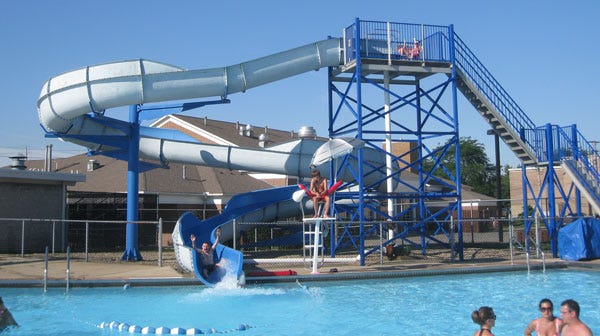
Willoughby Municipal Pool was first opened in 1965. Over the years, it was added to and changed, so that by my prime swimming years it featured a pretty good waterslide, a high and low diving board, and a kid’s pool with splash and spray features that rivaled those at some amusement parks.
The great thing about the pool was that it was truly for everybody. There was a shallow end where elementary age kids could splash around and play Marco Polo. There were roped off lap lanes, where the swim team practiced and where older citizens swam laps, there was a deep end where middle and high schoolers tended to congregate around a water basketball hoop, and there was the area reserved for diving.
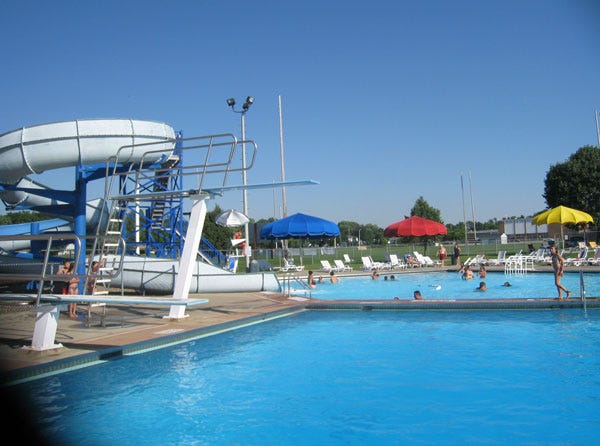
The pool opened early in the morning for swim team and swim lessons. High school students who doubled as lifeguards taught younger kids how to swim during this time.
At 1:00pm, the pool opened to the public and it became swarming with kids of all ages. Many parents who couldn’t afford or didn’t want childcare would drop their school age kids off at the pool to spend the day. They were vaguely watched by lifeguards (who referred to these kids as “pool rats”), but would also clump together into groups of similar aged kids. Every hour, there was a ten minute rest period where lifeguards took a break, kids had to leave the pool, and adults could enjoy swimming without youngsters splashing around them.
The pool featured a concession stand with the usual bad, processed foods of the era: nacho chips smothered in orange liquid cheese, hot dogs warmed on a rolling grill, soft pretzels that came from a freezer and warmed in a glass case under hot lamps. There was a soda vending machine that served Coke and Dad’s Root Beer.
At dinner time, the pool would close to kids for a half hour, and at that time, most of the pool rats cleared out. The pool closed in the evening, but was available for private parties after the official closing time. Many, many kids had their birthday parties at the pool over the years, and those parties were often the highlight of summer.
As I’ve been doing my daily cleaning of my backyard pool this season, I can look over and see my neighbor’s pool too, and it makes me miss the Municipal Pool in Willoughby. Each of our individual pools take a lot of water, a lot of energy, and a lot of chemicals to maintain, and we only end up using our pool for a few hours each week, even at the height of summer.
A collective model like I had growing up seems to make so much more sense to me. Why have each home be responsible for the care and maintenance of a private pool when instead, there can be a central community resource where those costs and benefits are shared by all?
There’s of course a middle ground here, which has become popular in newer neighborhoods over the last several decades: the neighborhood pool shared by residents of a specific development, usually as part of a homeowner’s association. These help towards the goal of collective maintenance, but I think they exclude something important about community.
Our municipal pool was available to all members of the community (or anyone else who wanted to drive to our pool and pay the small admission fee). Willoughby had big houses, it had small houses, it had townhouses, and it had apartments. People from all socioeconomic backgrounds could mingle at our pool and feel a shared sense of place, whereas HOA pools tend to be accessible only to folks living in a homogenized place where most homes are of the same size and most residents of a similar income bracket.
In many cases, private pools (either in individual backyards or as part of an HOA) are a reaction to the integration of municipal pools during the Civil Rights era. Heather McGhee has written about this and I discussed it with B. Brian Foster and Richard Frishman on my podcast last year. Willoughby wasn’t perfect (they continue to use a racist team name for their high school), but its pool opened in 1965 and to my knowledge was integrated from the beginning.
The municipal pool also provided an important outlet that private pools do not: an opportunity for teenagers to work. Nearly every lifeguard, concession stand worker, and swim instructor at the pool was a high school student, with a few managers being in their twenties. The swimming season lined up perfectly with the school vacation season, meaning getting a job at the pool was a good way to keep teens engaged in the community and earn some money.
As I wrote about a few weeks ago, these options for teenage jobs and the valuable experience that comes from them are becoming rare. At the Municipal Pool, teens were literally charged with guarding and saving people’s lives. Having that trust placed in a young person builds character and life skills.
This rejection of the collective for the personal appears in more places than just pools too. Homes now come equipped with bookshelves to store personal libraries, rather than borrowing books from a local library and treating reading as a community resource. During the pandemic, businesses thrived that sold books in bulk for the purpose of making a home library or Zoom background look more full and its owner more well read.
People buy Pelotons and other home gym equipment rather than invest in community fitness programs. Elaborate backyard swing sets take the place of neighborhood parks, where people of all ages used to socialize. I’ve even written about the strangeness that every resident of my street owns their own lawnmower or set of wrenches, when a collective model would benefit everybody.
Our houses grow increasingly larger each year because we are expected to absorb more of what was once the public realm into our private spaces. In the case of our swimming pool, we didn’t even make the decision to install it. The last owners paid for that upfront cost, but now we are responsible for the ongoing maintenance. Our choices seem to be keep it going or pay to fill it in. There’s no half-step in between.
It’s worth noting that the pubic pool that I just spent the last few paragraphs celebrating closed last year because the repair costs to continue to maintain it were too great for the city budget. Supposedly a replacement pool is in the works, although it will likely be a few years before that opens, if it ever even happens. Willoughby opened a second municipal pool about 25 years ago that now serves the city in the interim.
Thanks for reading Willoughby Hills! Subscribe for free to receive new posts and support my work.
Related Reading
What Does It Mean to be “Old”?
The Many Incarnations of Toys R Us
If you’ve missed past issues of this newsletter, they are available to read here.
We are about to move to New Hampshire and have been considering a house with a pool. You convinced me to bypass that house with your description of the maintenance!
Heath, thank you so much for sharing this thoughtful piece on your experiences and observations on swimming pools and community. As a kid growing up in DC's MD suburbs I always thought it was a special treat to swim at any friend's whose family had their own pool; my family belonged to a neighborhood pool very similar to the one you describe.
My own (grown) kids also grew up swimming and working at such a neighborhood pools in Northern Virginia. Through all my own decades as a Masters swimmer and my kids' years on swim teams, I confess I didn't dig deeper to understand why the sport was so white given NoVA's relative diversity, despite reflecting on it all the time.
Around the time of George Floyd's murder, when local Virginia schools were renaming high schools purposefully named after Confederates in the 60s, I finally learned the history of racism and segregation in our neighborhood swimming pools. And the lasting, harmful impact this has had on the Black community. Reparations particular to swim are owed!
Crossing the Lane Lines with Naji Ali, a podcast series on the history and vibrancy of swim in the Black community, was a huge source of learning and inspiration to me. I maintain that both USA Swimming and USMS remain harmfully uncommitted to putting serious dollars behind increasing diversity in the sport and teaching all Black children to swim.
In the post-fascist world I imagine--when our defense industry doesn't outspend that of the next 9 countries combined--all children will have free access to a community pool. And basic swim and water survival classes and certification would be a fully funded requirement for all school children.
Thanks for reading! ; -)
https://open.spotify.com/episode/4eAwj8hni4iIfzzOXeGZgP?si=sLZqwCKqT-iI3t4FyY