


Welcome to another edition of Willoughby Hills!
This newsletter explores topics like history, culture, work, urbanism, transportation, travel, agriculture, self-sufficiency, and more.
Massachusetts was supposed to be one of the places where climate change might be felt less acutely. That’s not the case anymore.
A few weeks ago, our skies were orange for a number of days because of wildfire smoke traveling from Ontario to Boston and beyond. Stepping outside at midday, I could see a ball of light in the sky, but with so much smoke in the upper atmosphere, the light coming from that ball was diffuse. There were no rays of sun. It was difficult to discern what time of day it was. Every hour felt like 7:00 pm, even at 10:00 in the morning.
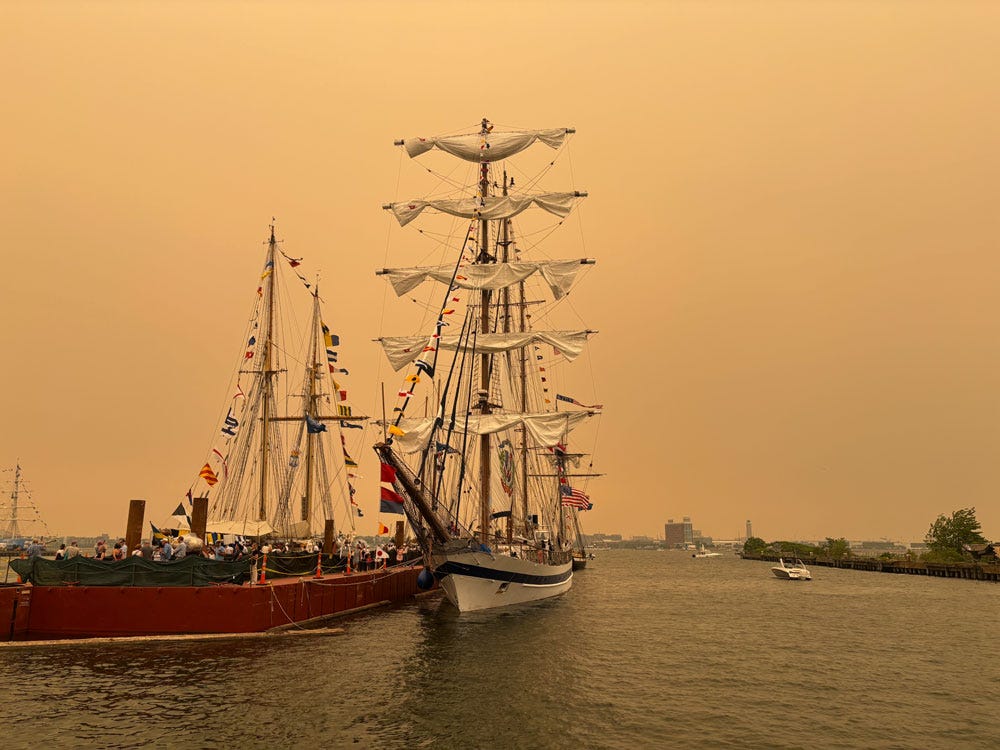
This smoke made it feel like rain was coming, but nothing fell from the sky.
After the smoke cleared it did rain. And rained and rained. Except the rain wasn’t like any other rain I had experienced in my more than two decades living in Massachusetts.
It was like a monsoon rain. It was hard and heavy and dense.
There were flash flood warnings in my area. I didn’t really know what that meant or what to do. I was driving at one point when I came across some flashing lights up ahead. There was a police car and some other official vehicle blocking one lane of traffic on a two lane country road.
I realized that a stream must have swelled, or maybe a new one appeared out of nowhere, and it had breached the road. The blocked lane was too deep to pass. The open lane was still covered in water, but enough that it seemed reasonably safe to traverse.
The officials were there to alert traffic to the hazard, but they weren’t really able to do anything about it. There was nobody trying to reroute the water or somehow block it or pump it away or do anything to stop it. They were helpless. We were helpless. The water just kept coming. All we could do was keep driving.
I’ve been feeling pretty helpless against all of these climate impacts, and these ones in my part of the world are relatively minor. There are wildfires in Washington, drought in the Midwest, and extreme heat all summer long happening just here in the U.S. over the last few weeks.
I feel like I’m doing my part as best as I can. Our house has solar panels to supplement our electricity production (but not enough to cover all of our needs). We removed all fossil fuels in our home when we moved in, cooking on a used electric range that I bought off of Craigslist (replacing propane) and heating and cooling our house with a new geothermal system.
I am conscious about waste, using cloth napkins and packing lunch in reusable containers rather than ordering takeout. Most of our produce, meat, and dairy is sourced from local farms and are outside of the industrial food system.
And yet, I often question if I’m doing enough.
When the sky is orange or the clouds are dumping buckets maybe I should be chained to a pipeline or interrupting politicians or oil executives or something?
I absolutely think there’s a place for those acts of defiance and the spotlight they can shine on the issues of our time. But recently, I’ve also been met with a different kind of activism, a quieter one, perhaps even a harder one to practice.
It’s about education and changing minds in our own community. It’s about sharing our knowledge with one another and influencing behavior at a very small scale.
When we moved to Western Massachusetts two years ago, my wife found an amazing hair stylist. She’s a woman in her 70s who retired from tedious salon work, but still cuts hair for friends and family in her own home on her own schedule.
A few weeks ago, I was getting a haircut from her and chatting about the state of the world. She told me that she was equally as concerned with the climate emergency, wondering what future her teenage granddaughter might inherit, so she decided to do something.
She and a number of other local mothers and grandmothers began meeting and talking. They weren’t focused on how to stop Shell or BP or to demand national policy changes. Instead, they wanted to form plans to make real change in their town.
These mothers and grandmothers started talking to the local electric utility. They happened to have a municipal utility, which meant it only served their town and wasn’t part of a big conglomerate. They were able to get meetings with the people who made decisions for the electric company and discuss issues that mattered in their town.
Through these conversations, the mothers and grandmothers learned that one problem in their town was excessive energy spikes on very hot afternoons in the summer. Essentially, everybody would come home from work and between roughly 3-7pm on hot days, their air conditioning would all run full blast.
This caused a big spike in demand for electricity. The utility either needed to figure out how to generate more power for those occasional brief periods (which meant more fossil fuel consumption in the short term and possibly new power plants in the long term) or they risked damaging transformers and brownouts and blackouts, where the entire town might be without power because the utility couldn’t keep up with demand.
My hair stylist and her friends worked with the utility to set up a text message alert system in the town to let neighbors know days when the system was expected to be taxed. Their ask was small and simple in those messages: run your AC a little less during that peak usage period so that everyone could continue to have power and as a community, they would use less. They also did some educating about the importance of using less energy.
I’m sure there are plenty of people that ignore those messages and keep their AC running at 68ºF, whether or not it impacts their neighbors or even leads to a blackout in their own home. But I’m sure there are also plenty of people that realize that they’re still comfortable at 75ºF or even 78ºF, whether for a few hours or even around the clock.
I don’t think the people in that latter group that adjusted their thermostat were intentionally trying to use excess power before. They likely just didn’t have the education to know better or even thought to tie the settings of their air conditioner to power usage and pollution.
Most people don’t want climate change to impact them, but they might not know how to take action. “Fuck Exxon” is a great slogan and it’s accurately assigning blame, but it’s also not something most regular people can do anything with.
Changing their air conditioning settings are something tangible and real. And it wouldn’t have happened without these mothers and grandmothers choosing local activism and community education.
This goes back to an idea I’ve written about many times before. We all can’t do everything to fight the bad things in our world. But we all can do something.
Education matters. Community engagement matters. These are harder work than just yelling into the void of social media or talking with people who already agree with you. But it’s where real change happens.
And of course, change also happens with each of us. We can’t control anybody but ourself, so if we truly want a different world, a better world, we need to do that tough work of self reflection and self assessment.
It can feel disheartening, but little actions to add up. In baseball, it doesn’t matter if every run scored is a home run. Singles and doubles matter. Walking a batter still gets somebody on the base who might score later.
Sometimes just getting to first base is a victory. Start there. You’re already on your path to home plate. But don’t just stay in the dugout.
Thanks for reading Willoughby Hills! Subscribe for free to receive new posts and support my work.
Related Reading
Nobody Knows What You’re Talking About
If you’ve missed past issues of this newsletter, they are available to read here.