


Welcome to another edition of Willoughby Hills!
This newsletter explores topics like history, culture, work, urbanism, transportation, travel, agriculture, self-sufficiency, and more.
This is a story about my eighth grade English teacher.
I won’t name her, because her name doesn’t really matter. She could stand in for any other teacher in any other grade teaching any other subject.
The truth is, I don’t remember much about her class. I think we probably read some classic books in it. Of Mice and Men? Maybe that was actually ninth grade. I’m sure we wrote some essays, maybe even some works of fiction. The subject of any of my writings at that age escapes me.
I have only one very distinct memory of that teacher: how she made me feel when she was wrong. And she was wrong about something important, which helped me define my own perspective on the world. It wasn’t the lesson she was trying to teach, but in her ignorance, she shaped who I became.
I entered eighth grade in the fall of 1998. Jonathan Larson’s groundbreaking musical RENT had opened two years earlier on Broadway, shortly after Larson died at the age of 35 of an unexpected aortic dissection.
Larson’s tragic death as the show was in previews also put the production under a microscope in a way that original cast member Daphne Rubin-Vega recently described as “rubbernecking.”
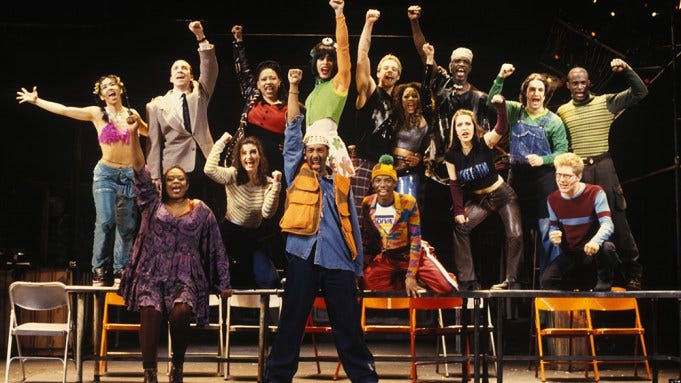
“Seasons of Love,” the song which opens the second act, played on the radio frequently. The cast sang it on nearly every show on television, from The Late Show with David Letterman to The Rosie O’Donnell Show. RENT in the late 90s is what Hamilton was in the late 2010s. Pervasive. Popular.
RENT is the backdrop to this story, but it’s also an important backdrop to my adolescence. The show was celebrated for its diverse cast, its candid discussion of the AIDS crisis, and its rock music soundtrack.
I was a cis, straight kid who lived a comfortable suburban life who longed for the life of a struggling artist. The closest I could get to the Bohemian lifestyle of the RENT cast was visiting a store called Record Revolution in Cleveland Heights, about a half hour from my hometown.
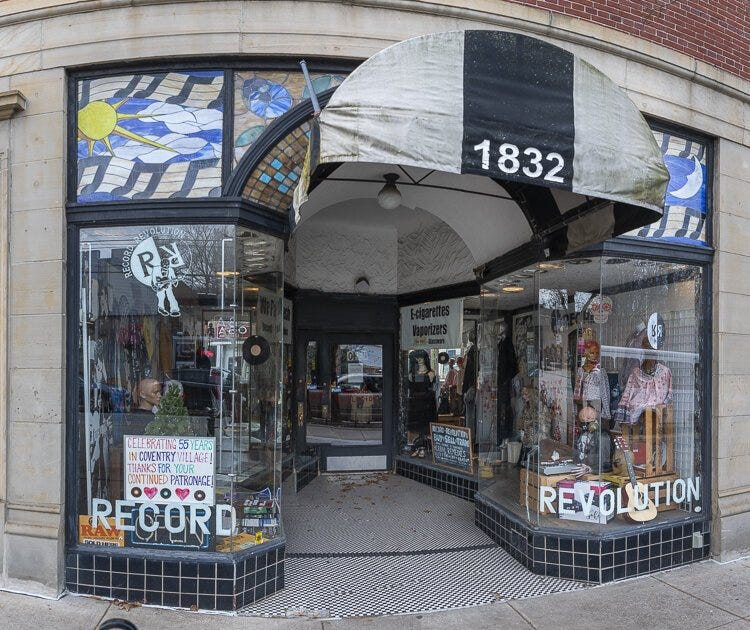
Record Revolution opened its doors in 1967 at the height of the hippy era and closed in 2022. Throughout my childhood it remained largely unchanged. Upstairs, it housed a collection of vintage clothes, Doc Martens, incense of every scent imaginable, and marijuana pipes (with the requisite “for tobacco use only” label). Downstairs, the dark warren of a basement was stocked with LPs and CDs.
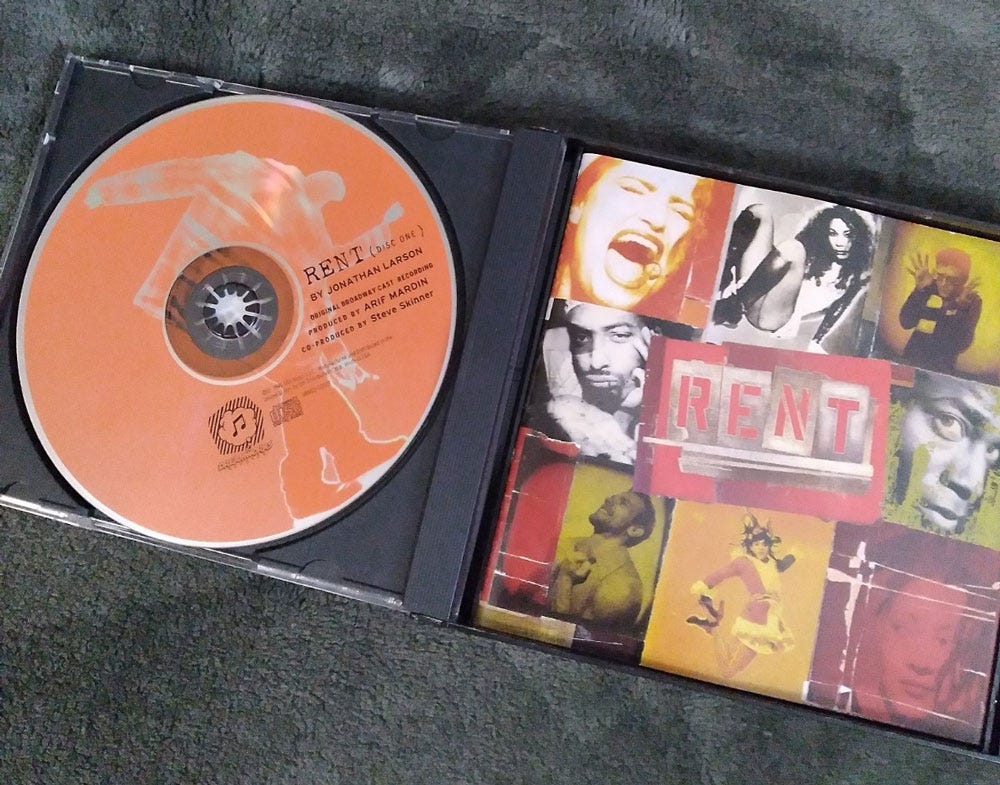
I remember visiting that basement as a seventh grader and finding a used copy of the newly released RENT two-disc set. My recollection was that it was pricey for a used CD, but something called to me about it and I bought it. Maybe it was buying that soundtrack in that particular store that felt a little more authentic. At any rate, it was clearly a memorable experience as I can recall details of that purchase nearly 30 years later.
The RENT CD set played on repeat in my bedroom for much of my middle and high school years. I didn’t fully understand the plot of the show just from the music or even really know who the characters were, but I was still hooked.
By eighth grade, RENT’s touring company had a run of shows in Cleveland. I don’t remember if I had begged for tickets or if my parents offered it, but somehow one day my mom and I were sitting house left in the orchestra, maybe five or six rows from the stage.
I had seen a few live stage shows before RENT, but nothing quite compared to that experience.
Even if you haven’t seen RENT or don’t exactly remember the characters or plot points, you’ve probably heard “Seasons of Love.” That song really is the distillation of the entire point of the whole musical: how love is at the heart of the human experience and how our interaction with love can change at different points of the year or at different points throughout our life.
RENT featured a multi-ethnic cast: white, Black, Latino, Asian. And it showcased many different expressions of love and gender identity. There’s Maureen, the white female from Long Island who was in a relationship with Mark (a Jewish male) until she leaves him for Joanne, a Black female Harvard graduate from a politically connected family. Maureen and Joanne struggle with issues of trust and monogamy. They break up. They get back together. There’s dimension and realness to their relationship.
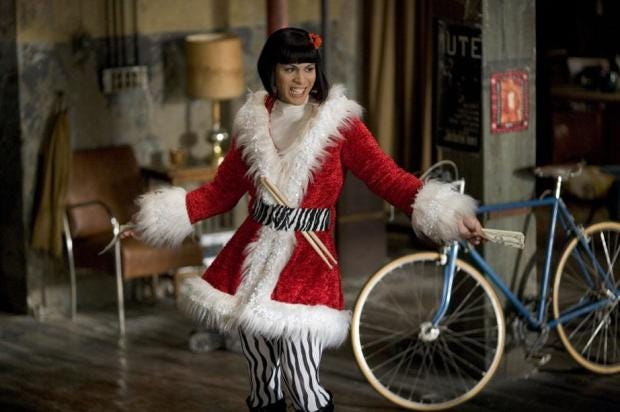
Another important romantic pairing in RENT is that of Tom, a gay Black professor who falls for Angel, a Latino drag queen. At the beginning of the play, Angel is very masculine presenting, wearing a puffer coat and a knit skull cap while drumming on a plastic bucket, though Angel later changes into a fabulous Santa-inspired dress with zebra-print tights. Different characters use different pronouns for Angel throughout the show, sometimes using “he” and others “she.” In the context of the show, none of this feels contradictory or confusing, even in the late 1990s. Angel can represent one gender, both genders, or no gender all at once. The label of Angel’s gender doesn’t matter and neither does any attempt to categorize Angel and Tom’s love story. The love is real and palpable.
RENT also depicts straight couples, most memorably with the relationship between the white HIV-positive musician Roger, who falls in love with his neighbor Mimi, a Latina drug addict who works as an exotic dancer. There is no judgment placed on either character for their life choices or circumstances. Addiction, stripping, and even an AIDS diagnosis (which was almost always fatal during the time RENT is set) are seen as part of life, not a stereotyped shortcut to an archetype.
No character is seen only through one lens, but for the complex personality that all of those parts add up to. They are viewed with love. Painting such a full portrait is difficult to pull off in three hours, but somehow Jonathan Larson is able to do it for most of the core cast.
I still remember little eighth grade Heath watching this show and being so moved by the depth of it. As I’ve written about before, I was raised in a very homogenous suburb. It was so white that the high school I attended proudly flew the Confederate flag for decades to cheer on the “Rebel” sports team. (For a deeper dive into this, listen to my podcast episode with Akilah Hughes).
It seems hard to believe now, but in the late 1990s, I barely knew any people of color and certainly didn’t know any gay people who were out of the closet. There weren’t even that many people out in popular culture. The “coming out” episode of Ellen had been a big turning point the spring before I saw RENT.
RENT taught me to see people for who they were and how they wanted to express themselves: in gender, in sexuality, in art, in fashion. It humanized love across race, class, gender, and more, showing that love is universal and all people are worthy of it.
These were big ideas for my eighth grade brain to wrestle with, but they were important.
Which brings me back to my eighth grade English teacher.
She was a politically conservative woman. She dressed in long dresses that went to her ankles. She led prayer groups for Evangelical kids after school in her classroom.
And she happened to see RENT the same weekend that I did.
I remember returning to school Monday morning wearing the RENT sweatshirt that I had overpaid for at intermission, still in the joyful fog of experiencing a fresh perspective on the world.
Then, that teacher brought me back to earth.
“You saw RENT too?” she asked me.
I didn’t pick up on the disapproval in her voice. I was still a kid who was happy to share my thoughts freely with the world. “Oh yes! It was so lovely. I was so moved by…”
I started gushing over the play, but my English teacher interrupted me.
“Guys kissing guys on stage?” she asked incredulously, then she began sticking her finger in front of her mouth and making a gagging sound, mimicking vomiting.
All of the late Jonathan Larson’s hard work. Four Tony awards. Endless acclaim. My own awakening and understanding after seeing the show. All of that was reduced to a homophobic reaction and a crude gesture.
I wasn’t going to stand for it.
“You don’t understand. The whole point of the show was that everybody is deserving of love-” I tried to argue the best I could as a middle schooler.
Again, I was interrupted. “Guys kissing guys on stage?” Gag.
I was undeterred. “But that’s the whole point. Love is love-”
A third and final time, this one louder, and with more authority and frustration: “Guys kissing guys on stage?!” Gag.
She said it with an undertone which clearly implied “you’ll be going to the principal if you don’t cool it” even though I wasn’t in the wrong.
I was angry. I was upset. I was disappointed that this adult who was supposed to be guiding my learning clearly didn’t get it. There was also so much cognitive dissonance. There are men who kiss each other in the show, but there are also women who share same sex kisses on stage. There was swearing. There was some mild nudity. The whole soundtrack is largely blaring electric guitars. What was it about the gay men that she found so offensive, while seeming to let the other parts of the play slide? Or how did that become her one and only takeaway?
I saw RENT again when it came to Cleveland, then saw it on Broadway a few years later. That teacher didn’t dampen my enthusiasm for the show, nor did she change my mind about the universality of love.
As I’ve grown older, I’m surprised how vividly that moment still sticks in my mind. I think about the gay friends I knew who were in the classroom that day. None of them were out yet, but I can’t imagine what message they might have received from her. Heck, she had no reason to assume I wasn’t gay. I was a theatrical kid who dressed eclectically in school and I think many of my friends, teachers, and others in my life probably suspected that I might be, or at least questioned my vibe.
In a weird way, that encounter forced me to confront my own views and solidify them in my own mind. RENT moved me to become an ally. As an eighth grader being told by a teacher that something is wrong, it is just as easy to accept that as fact. I had been conditioned through years of schooling to believe that teachers always had the answer. Pop cultural references like Boy Meets World, or The Magic School Bus seemed to reinforce this idea. The teacher was always right.
But my eighth grade English teacher was wrong. So very, very wrong.
I’m glad I could recognize that then. And more importantly, I’m glad I was able to stand up to her, even if I didn’t change her mind.
I remember the gagging motion and sound she made after she saw RENT, and when I think of her now, that gesture seems the most appropriate way to remember her. Her ignorance and homophobia still make me gag, nearly 30 years later.
Sadly, RENT closed its Broadway run in 2008. If you never had the chance to see it in person, the final show was recorded for a DVD release, which was later uploaded to YouTube.
Thanks for reading Willoughby Hills! Subscribe for free to receive new posts and support my work.
Related Reading
If you’ve missed past issues of this newsletter, they are available to read here.
Oh, Heath! I had no idea you loved Rent back then. I saw it on Broadway in 10th grade and listened to the soundtrack so often afterwards that I still remember almost all the lyrics. I also had no idea that our English teacher was so wrong -- I keep mainly positive memories from her class, most notably Jake writing sentences with our vocabulary words every week and somehow fitting in the full title of "Dr. Strangelove." I had the impression that she was "one of the good ones."
So many of our teachers were wrong - from science in 7th grade when the teacher spent a good half of class explaining that she HAD to teach us evolution because the state required it, but it was just a theory, and she would never test us on it because it wasn't true; to social studies in 8th grade when our teacher asked which direction was north, you pointed in the correct direction (I remember being so impressed because I have never had any sense of direction), and him shouting WRONG over and over again at you. His argument was that you could never know which direction was which without a compass... which is simply not true. That same teacher later told me that the Constitution didn't apply to me if I was an atheist because our rights came from God. We were lucky to get out of there alive!
But back to RENT, I feel as though Jonathan Larson would probably not have been bothered by Mrs. P's reaction. It makes me think of the scene in the restaurant when they all sing "La Vie Bohème" - they WANT to shock Benny and the traditional restaurant clients; they're proud of their idiosyncracies and their choice to live on the margins of polite society. They don't care what people are saying or thinking about them because they know that they're in the right. Benny's the big loser in Rent, and Mrs. P is the big loser in life - think of all the great art, music, and relationships she's probably missed out on by being homophobic. Good on you for seeing it so clearly in 8th grade.
I grew up in South Euclid and would spend hours every month in Record Revolution, the Record Exchange, and Big Fun.