


Welcome to another edition of Willoughby Hills!
This newsletter explores topics like history, culture, work, urbanism, transportation, travel, agriculture, self-sufficiency, and more.
A BJ’s Wholesale Club recently opened near us.
For those that don’t know, BJ’s is a membership club that sells in bulk, similar to Costco or Sam’s Club. Their headquarters is here in Massachusetts and for a long time, I thought of them as a Northeast-specific chain, although they now operate in 22 states. There’s a good chance you might be familiar with them, as their reach these days stretches as far south as Florida and as far west as Texas.
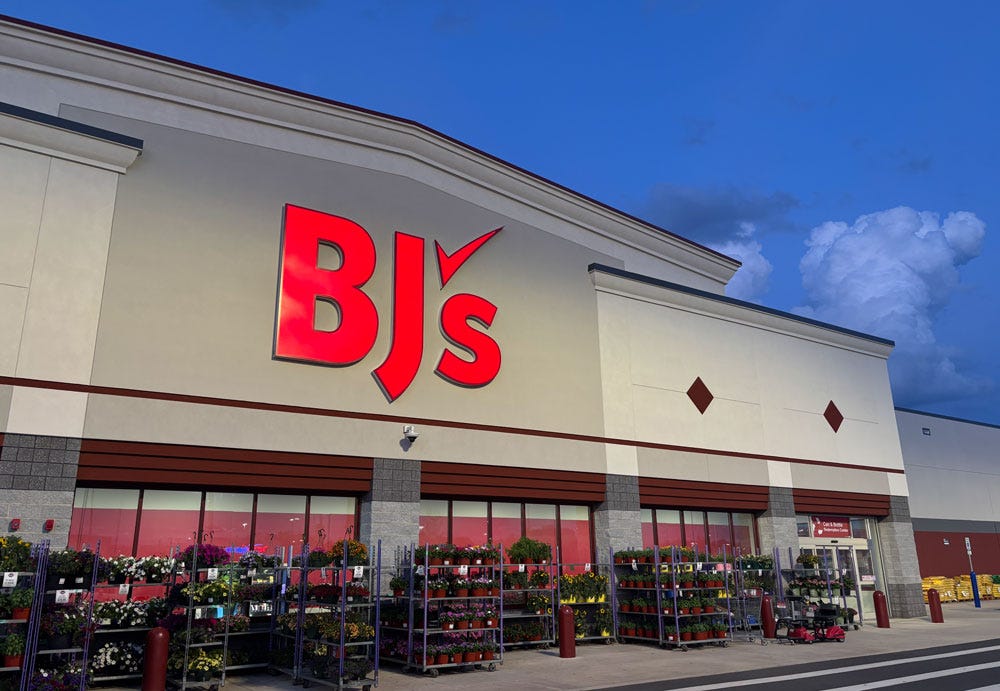
As I’ve written about before, we’ve been Costco shoppers for years, so even though there have always been BJ’s locations not far from our houses, we’ve never really ventured inside of them. In fact, the last time that I was a regular BJ’s customer was back in high school when BJ’s opened as part of a new shopping center in my hometown of Willoughby, Ohio and my parents had a membership.
I hadn’t planned to shop at the new BJ’s near us either, until a family member decided to try out membership and added me their account. With no barrier to entry, it seemed worth trying out the new store and seeing how it compared to Costco, other grocery stores, and other big box stores.
This new BJ’s has only been open for a few months, so it still seems pretty quiet in the store. The first time I went with my wife and kids, we spent some time browsing every aisle to see what was new, different, or enticing. We wanted to get a feel for this new store and see if it was somewhere we would return to with any frequency.
About halfway through that first visit though, I froze. Rolling down one of the aisles slowly, methodically was some kind of robot.
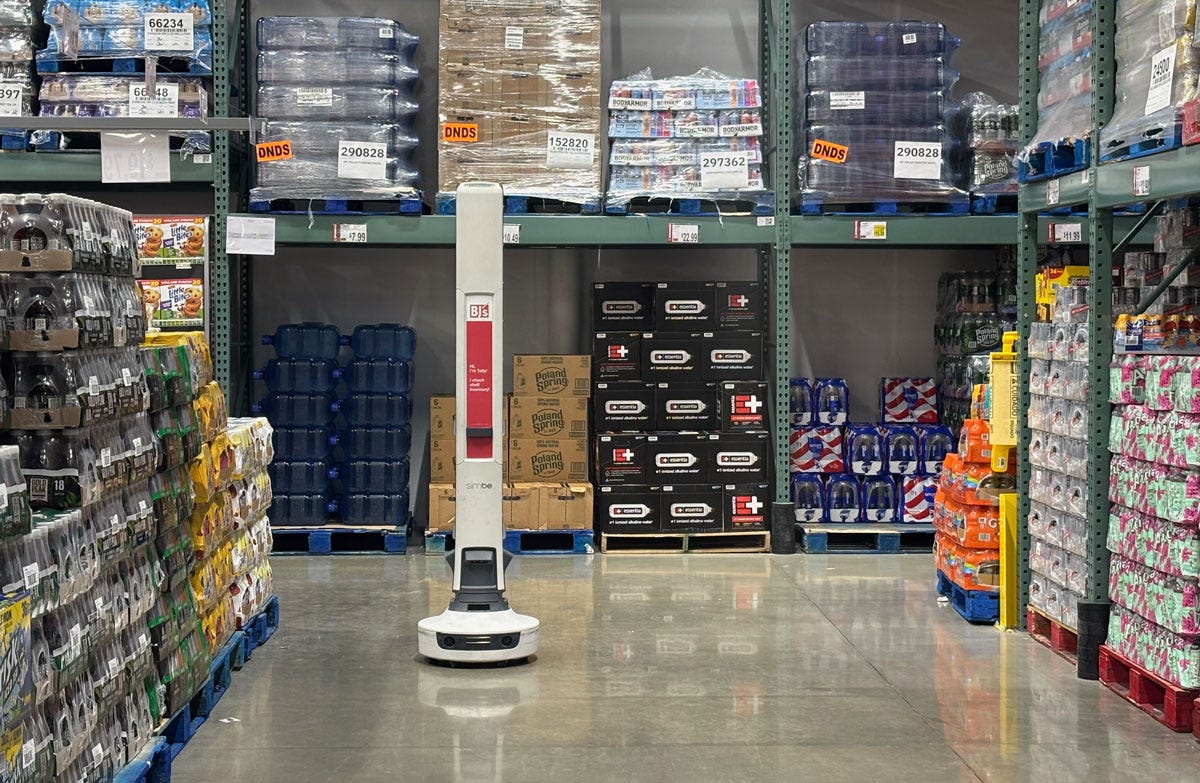
The base of it resembled a Roomba vacuum, a round disc maybe eighteen inches in diameter that could spin in any direction. Mounted atop that Roomba base was a large white column that resembled those old security sensors at the exit door of stores. It stood maybe six feet tall and was just rolling around up and down the aisles.
I had an immediate visceral reaction to it and it wasn’t a positive one. I encouraged my family to stay far from it, afraid of what it might be detecting.
I knew that Boston area Stop and Shop stores (owned by Dutch conglomerate Ahold Delieze) had been deploying robots to roam their aisles and monitor for spills since 2019. That’s a pretty scant job description, so I always suspected they were doing more than just that, but that’s the company line. I had seen these robots on social media, which have giant googly eyes glued on to make them appear more human or maybe to lighten the tension.
According to a 2024 Boston Magazine profile on the Stop and Shop robots by Joanna Weiss, these machines known as Marty have become local celebrities:
“Five years after he started working in Stop & Shop stores across the region, Marty has stumbled—slow-rolled, if we’re going to be technical—into an accidental second life as a brand ambassador. He visits elementary schools and college classrooms. He made an appearance at Fenway Park. He’s been dressed in Christmas sweaters. He’s inspired a line of plush dolls and a slew of social media posts and stan accounts, including @marty.b.robot and others.”
I’m not sure if Marty is actually beloved or if it just has a very active and well connected publicist.
At any rate, seeing a robot roam the aisles of BJ’s was my first time encountering one of these robots in real life, and I was not a fan.
My first reaction was that this rolling robot was deployed for loss prevention purposes. I could imagine this robot tracking faces, following suspected thieves, or gathering evidence of shoplifting.
I left BJ’s that first time with an uncomfortable feeling. I didn’t like the idea of being spied on by this droid, nor did I like the idea that it might be watching my fellow shoppers. Something felt off about the whole thing.
I did some research and learned that these robots in BJ’s are made by a robotics company called Simbe based in the Bay Area. The robot itself is known as “Tally” and it’s meant to be an autonomous stocking and inventory tool.
According to the 2023 press release announcing the roll out of Tally in BJ’s stores:
“Tally autonomously roams club aisles multiple times per day, leveraging computer vision technology to collect highly accurate shelf data that ensures products are in-stock, shelved appropriately, and accurately priced. This real-time data unlocks powerful efficiencies that enables faster restocking, directs BJ’s team members and members to quickly locate products, and provides valuable visibility into inventory tracking.”
Boston.com cites a statement from BJ’s which claims:
“Tally has cameras that are used for guiding the robot and monitoring inventory. They are not used for watching our members.”
In other words, not surveillance. At least not officially.
Maybe my discomfort with Tally was singular to me. After all, according to Simbe’s own website, “People are more likely to shop at retailers with in-store robots.”
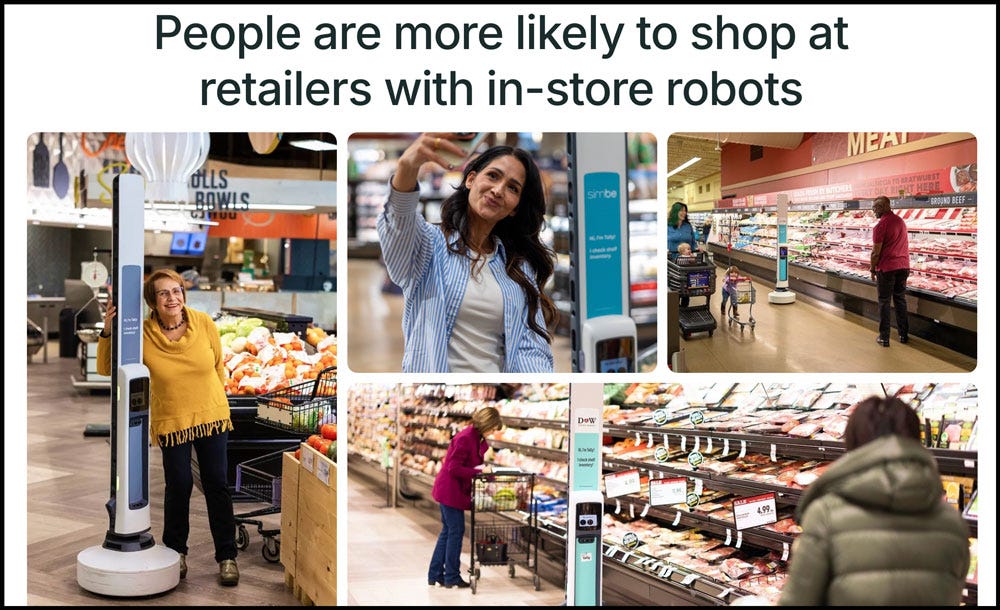
They don’t cite any data to back up that claim, just a bunch of photos of people posing with their robots.
The disgust I felt towards Tally made me not want to shop at BJ’s ever again. Had I been a paying member, it might have caused me to cancel my membership, although I was just free riding on a family member’s card, so I didn’t have that recourse.
I think that unpleasantness was related to the notion of surveillance, which supposedly isn’t even Tally’s job.
Of course, I know that surveillance in a retail store isn’t anything new. Upon entering BJ’s, there’s a TV monitor that shows a camera feed of the front door, a subtle clue that you are always being watched in the store.
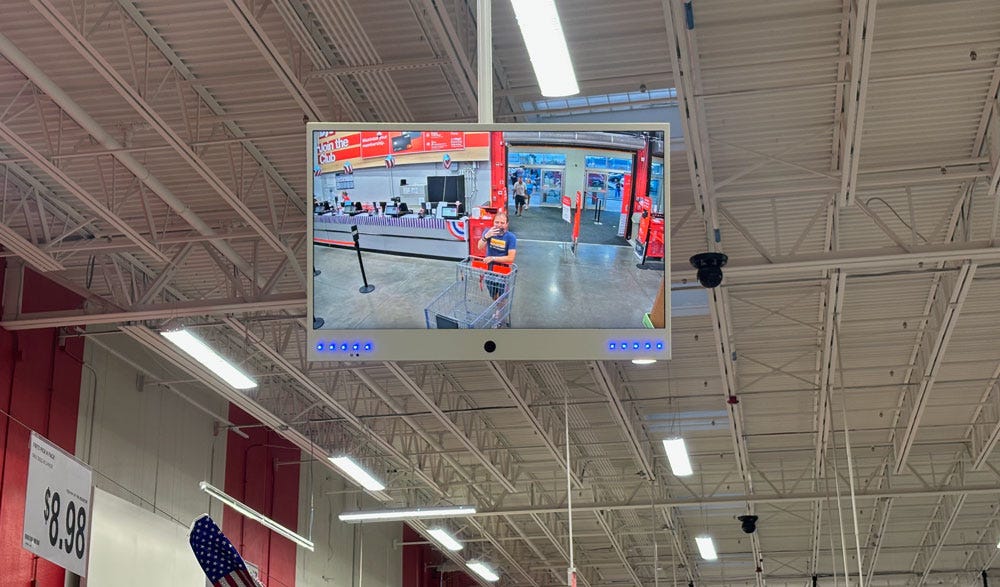
There are dozens of cameras all over the ceiling of the store too, covering every aisle. Nothing happens in a BJ’s, or really any corporate retail store these days, without it being recorded. There are probably more cameras covering the activities on the sales floor than there are showing the events at a professional sports game broadcast.
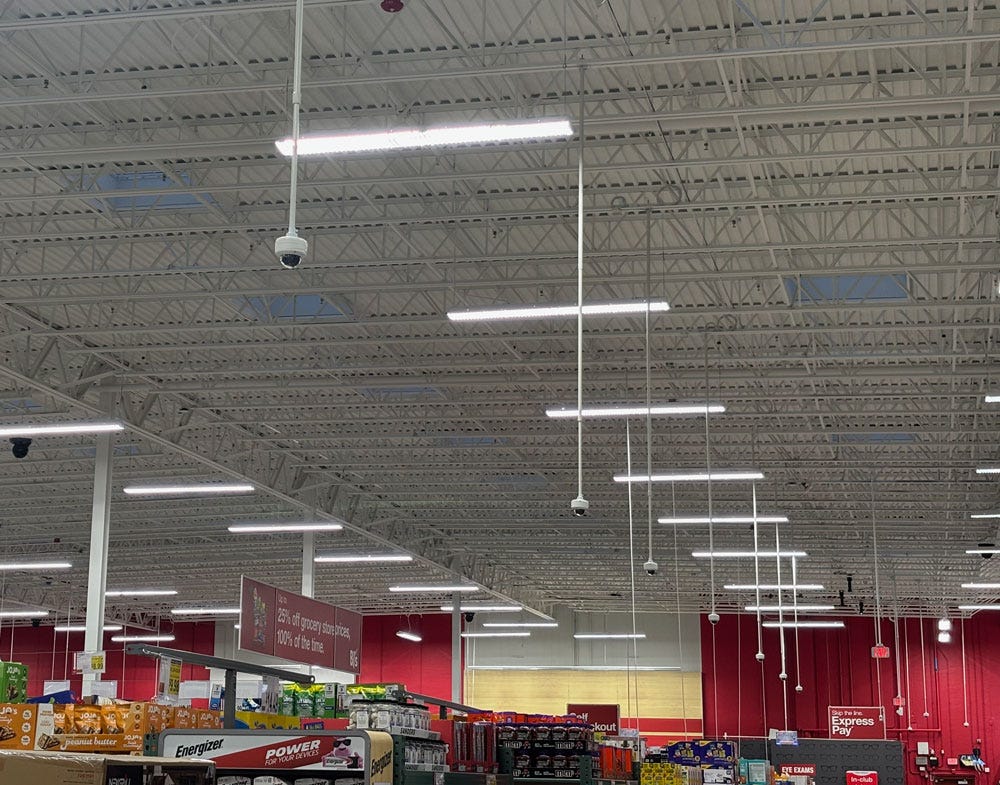
And this is not new.
In 2005, I spent a few months working as a manager at a Target store that was newly built. Even back then, there was a sophisticated network of cameras that not only recorded everything but were fully searchable.
If a customer told us that they were in yesterday and only realized when they got home that they had left a bag behind, it took our in-store security team less than five minutes to verify the claim with their receipt.
Just by entering the transaction number in the computer, the security team would immediately have a bird’s eye view of the entire exchange on their bank of monitors. They could see every button the cashier pushed on the keyboard, which bag every item went into, and what the customer was doing.
If the customer was lying, the security team could continue that video feed to see the cameras near the front door as they left with a bag and even in the parking lot where they loaded a bag in their trunk.
Again, this was 2005. That fall, I started at This Old House, a national broadcast television show, where we were still recording to tapes and filming in standard definition. Yet Target had digital storage of vast amounts of camera feeds, tagged with metadata, in high definition.
I can only imagine what that technology looks like today more than 20 years later.
The reality is that we are being tracked, whether we know it or not.
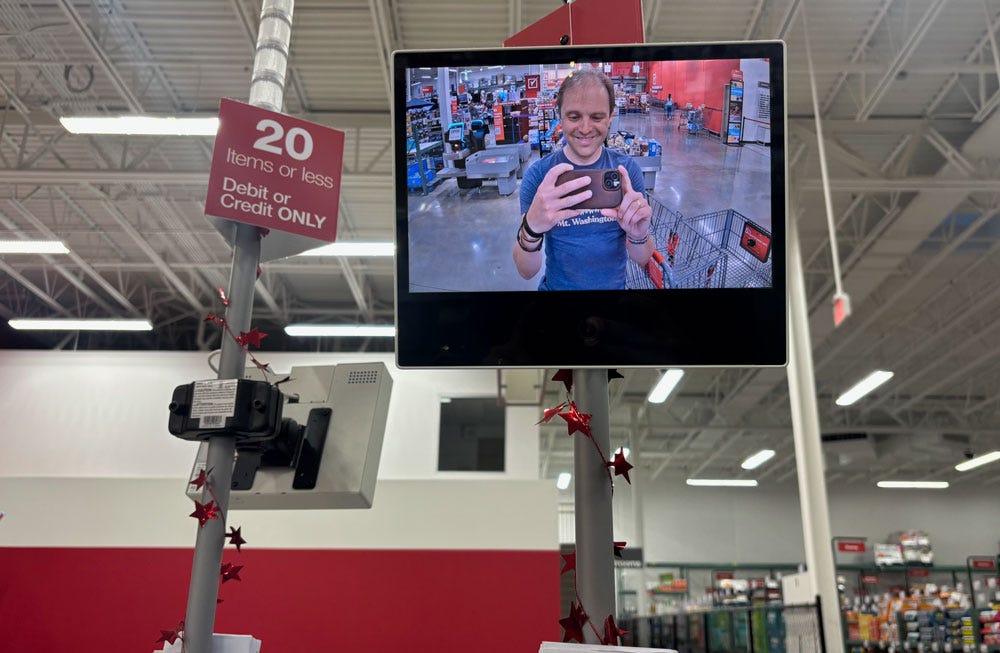
So why does it feel so icky to be tracked by a robot, even if that robot’s technically not even tracking us? What is it about this non-human entity that makes me so dang uncomfortable?
Because here’s the other strange thing: I’m not anti-robot. At least not fully.
I have a robot that vacuums the walls and floor of my pool for me. I used to have a robotic lawnmower (which was installed as part of a segment of Ask This Old House) that I generally liked, until it stopped working after a few years. I’ve known people with Roombas in their house, and they didn’t bother me in the same way.
Perhaps the difference is how these robots get their information. The devices I just cited don’t have any kind of visual input. They’re relying on accelerometers and other sensors to do their job, not cameras or microphones. They’re not able to “spy” on us in the same way.
Tally, though, is all cameras.
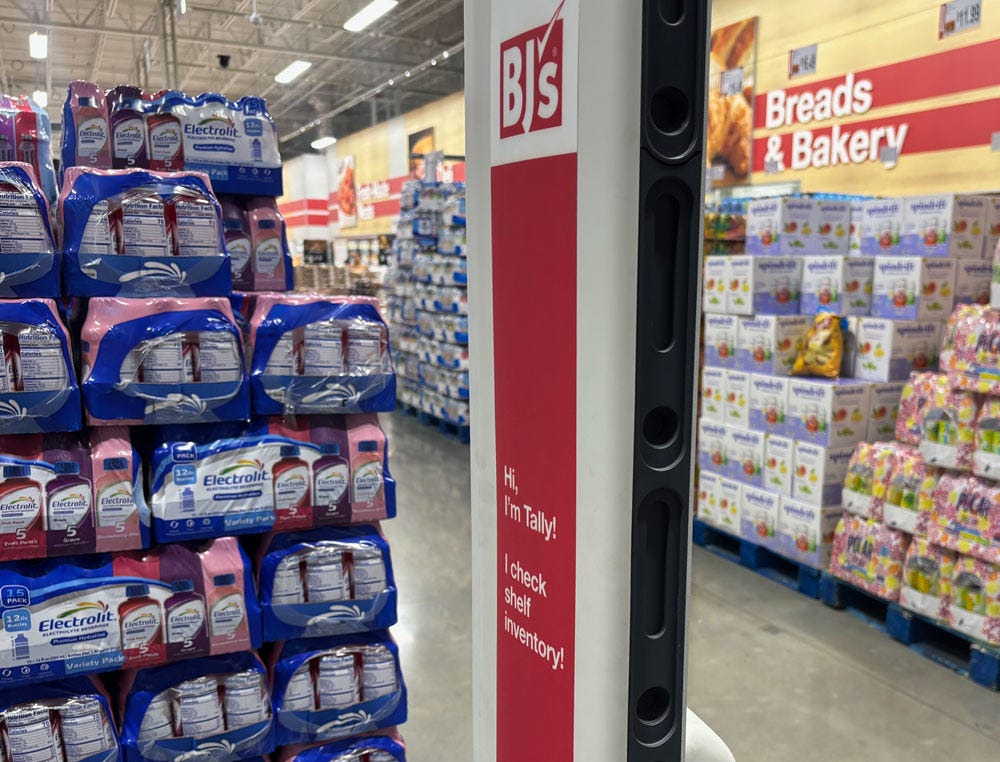
Maybe some people have a negative reaction to Tally because it’s taking the place of a human job. I don’t share that same concern, at least not as the most immediate problem.
This new BJ’s has something like six self-checkout lanes, four conventional checkout lanes with a human cashier (though I’ve only ever seen one open), and even the ability to scan items as you go on a phone app and bypass checkout all together (an evolution of Amazon’s Dash Cart concept that I wrote about a few years ago).
This store is already staffed with less humans that it might have been a decade or two ago. And that’s not entirely Tally’s fault.
I do think some of my reaction is coming from a shift in our relationship to tech, or at least my own relationship to it.
From the moment Steve Jobs unveiled the first iPhone, I wanted one. Ditto for the iPad (as I’ve written about). I was eager for smart light bulbs and smart switches and happily let Amazon listen to every conversation in our house in exchange for a music speaker.
Likewise, the early days of Facebook were a chance to stay connected with classmates that had scattered. Twitter was a way to meet others with similar interests or talk directly to influential people. Tesla felt poised to deliver an affordable and pollution-free solution for cars and climate.
We no longer live in that era of tech optimism.
In my family, the smart speakers have gone from our house for many years now and I dropped my Prime membership years ago. My phone has started to feel more like dragging around a lead ball than holding on to a climbing balloon. I prefer books and CDs to Kindles and streaming.
Mass surveillance seemed okay when it helped suggest the next song we might want to hear, but now it’s aiding ICE in arresting and deporting people and it’s not as cool. What once felt cutting edge and exciting is now terrifying.
This is to say nothing for adult and children’s unhealthy relationships with devices, a point of national conversation since Jon Haidt published The Anxious Generation in 2024 and a major plot point of this summer’s latest Toy Story movie.
We once thought tech would save us. It increasingly feels like it’s going to enslave us.
Getting back to Tally, and this is anecdotal, but it doesn’t even seem like it’s delivering on its promises at my local BJ’s.
I was recently in the store because I needed a large bag of baking soda to help clean and balance my pool. I was met with an empty shelf where the baking soda was supposed to be. When I looked overhead, there were two pallets way up on a high shelf above, inaccessible and wrapped in plastic.
In theory, Tally should have flagged that the display at customer level was getting low and instructed a worker to restock that section. Instead, I had to manually find somebody and ask for help. They had to bring in a giant forklift in order to restock. It was a huge process.
On another visit, I was considering buying some wild caught Gulf shrimp, but passed because there was no price tag on the shelf. On my second visit a week or so later, the item still had not been tagged. One week after that, there was finally a price tag hanging, but it was identifying the wrong item. Incorrect price tags and low inventory are supposed to be what Tally is there to solve. It didn’t do that for either one.
It’s unclear what role robots like Tally will play in our future. I suspect cameras and other sensors that are already in place in many stores, paired with some kind of AI algorithm, will prove more practical and more “hidden” than a rolling machine in the aisle.
Simbe has already started to look beyond robots, debuting Tally Spot, a sensor that can be placed in “high turnover” areas. While the company seems to lean heavily on their inventory management talking points, focusing less on loss prevention, they talk about Tally Spot as being used to monitor high value and high theft items and also to watch things like the bottom of the basket, where items can often be concealed and stolen out of sight from a cashier.
For now, Tally Spot is meant to compliment and supplement the work Tally is already doing. I could foresee a day soon where Tally Spot overtakes the need for robots.
Whether a robot, a camera, or a fixed sensor of some kind, it’s good to remember that we are always being watched. The time of tech optimism is over and there is no privacy in this digital age.
Thanks for reading Willoughby Hills! Subscribe for free to receive new posts and support my work.
Related Reading
If you’ve missed past issues of this newsletter, they are available to read here.