


Welcome to another edition of Willoughby Hills!
This newsletter explores topics like history, culture, work, urbanism, transportation, travel, agriculture, self-sufficiency, and more.
I grew up on the same street where my mom and her siblings had grown up. Most of my life, my grandparents lived six houses away from us in the same house that they had owned since 1961.
My mom’s younger brother (my uncle) had always been the neighborhood handyman, even as a young boy. He had a paper route at a young age and was often the kid hired to help mow lawns, chop firewood, or do various odd jobs, even at 12 or 13 years old.
I heard those stories growing up and always felt a need to follow in his footsteps. I took over the local paper route at age 13, walking door to door early every morning, distributing a newspaper on people’s door steps.
Sometime around the same age, I began to mow lawns for neighbors too. I started out by charging $6 per lawn. I didn’t edge anything with a string trimmer or blow off the sidewalks or driveways with a leaf blower. I simply did a few passes with our family’s walk behind gas mower, collected my money, and was on my way.
One summer when I was maybe still just 12 or 13, I got a call from an older woman who lived on the street next to ours, sort of diagonally behind my grandparents house. Her name was Miss Simmons (well, not really. I’m sure she’s long dead, but for some reason, I still feel the need to change her name for anonymity).
Miss Simmons was somewhere between 55 and 85. As I’ve written about before, people back then seemed older even if they really weren’t. By contrast, people today seem younger even when the number of their age is greater. Miss Simmons looked old, sounded old, and acted old, though I have no idea how old she actually was. She had lived in the neighborhood for decades. My uncle used to work for her when he was younger, and his recollection was that she was old even back then.
I didn’t really know her, but she told me that she had some work for me to do and asked if I was interested. I agreed and told her I would meet her at her house in the coming days.
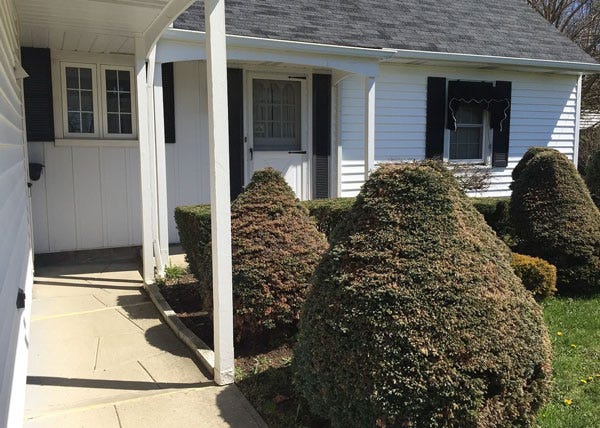
To my knowledge, Miss Simmons was a single woman who never married and never had children. She lived alone in her house, a small Cape Cod styled house built in the 1950s. I have no idea what she had done for work or how she was able to afford her home. By the time I knew her, she seemed to be retired, or perhaps had never worked at all (as women of her age often hadn’t).
Despite being an older home that didn’t seem like it had been updated in decades, everything was neat and tidy. The hedges were perfectly trimmed, the vinyl siding was a sparkling white, and the concrete walkway looked like it was brand new, despite being poured decades earlier.
Meeting Miss Simmons for the first time was intimidating. She was an incredibly petite woman. As a sixth or seventh grader, I was already towering over her. As I recall, she wore glasses and maybe even was a bit hunched over, making her already small frame appear even smaller.
Despite her diminutive size though, she had a large presence. She reminded me a bit of one of those tough middle or high school teachers who could command a classroom with just a look.
As I recall, her first task for me was washing her vinyl siding, and I believe she had me start on the side wall of her garage. It was a face of the building that was not visible from the street and was not visible from her house. Perhaps this was her way of assessing my skillset on an area that was low stakes. Or perhaps she was just that meticulous about house maintenance that she cared to scrub everything, regardless of if that cleanliness would ever be appreciated.
After she walked me through the scope of work, she informed me of what she was willing to pay. Despite this being a fairly labor intensive project that would’ve cost much more if she were to hire a professional crew, I can still recall exactly what she told me:
“If you were to work at McDonald’s, they’d pay you the minimum wage of $6 per hour. That sounds like a fair wage to me, does it to you?”
To be honest, I thought I should be paid more, but it was clear that this was a question with only one answer: “yes, ma’am.”
And so I began to scrub Miss Simmons’s vinyl siding, in an area where nobody would see my work. She provided me with a bucket, some soap, and some rags for manually washing down everything.
I may be conflating two or three different memories in my head at this point, so forgive me if this isn’t fully accurate. I seem to recall Miss Simmons was the type of lady who preferred to air dry her clothes on a clothesline in the backyard. I also seem to remember that the rags used to wash her home were made up of old clothing that had worn out beyond usefulness.
At any rate, my memory is that at least some of the rags used to wash her siding were made up of old pairs of her underwear, but it also could have been that I had simply seen her underwear hanging on a clothesline and am combining the traumatic sight of old lady underpants with having to touch old lady clothing scraps. Anything is possible.
I don’t remember how much of her house I cleaned on that first day, but I remember it taking about 90 minutes, for which I was promptly paid $9 in cash. I was exhausted, wet, and barely any wealthier than when I had started this work.
I didn’t really enjoy working for Miss Simmons. Over the course of the next few months, I remember going over there to do some other odds and ends. I probably finished washing the siding at some point. I think I did some weeding and pruning of her gardens. Considering how meticulous she was about the appearance of her house, I was surprised that she was entrusting this work to a young teenager with no experience, but sometimes affordability trumps effectiveness.
As time went on, the work seemed to become more vigorous and the resulting pay seemed less satisfying. I had always hoped that maybe these odd jobs would translate into something easier, regular, and more rewarding, like mowing her lawn each week. But that never happened.
I don’t remember why I stopped working for Miss Simmons. It could have been that I was already too busy with my regular lawn mowing customers and my paper route. It could have been that she wasn’t satisfied with my work and stopped calling.
Whatever the cause, there came a moment when I was no longer working for Miss Simmons. I was relieved and ready to move on.
Whether my time with her lasted a few weeks or a few years I don’t recall either. I may have only been to her house once or twice or it could have been an ongoing commitment for months or even a year or two. It’s funny how the more distant a memory becomes, the less accurate the details are. What was once a singular, discreet memory gets mixed with other ingredients until recollection becomes like a thick stew. The individual pieces melt and blend together to form something coherent, even if each ingredient is no longer what it started out as.
There’s no denying though that working for Miss Simmons was a formative experience in many ways. As a young person, I had to navigate interacting with an older person, one who was not used to speaking with children. I had to perform work that I wasn’t used to doing, and was expected to do that work to certain standard.
I recently stumbled upon a thread on Reddit where a young worker was been lampooned for not realizing that life in a corporate environment was different than life in high school or college. One of the overwhelming sentiments was that low wage, entry level jobs of all stripes (from customer service to fast food) were critical to building experience as a working adult.
I was a newspaper carrier. I mowed lawns. I spent several years at Toys R Us. And I worked for Miss Simmons. The pay may have been bad and the work tough, but doing those jobs mattered in ways I can’t fully even express right now. It’s bittersweet to know that those opportunities for early work are becoming less common for young folks.
Thanks for reading Willoughby Hills! Subscribe for free to receive new posts and support my work.
Related Reading
What Does It Mean to be “Old”?
The Many Incarnations of Toys R Us
If you’ve missed past issues of this newsletter, they are available to read here.
Hard to believe that many tipped wait staff today make an hourly wage less than the $6/hr that you made, Heath, 28 years ago. The National Restaurant Association lobbies hard against their making minimal wage.
Nice story. I have often wish for a teenager in our area that did odd jobs. I guess there are practical laws against it…especially safety & insurance coverage.
PS: I babysat for a quarter an hour in 5th grade…mid-fifties.