

Defending Our Castles
The urge to steal from one another

Welcome to another edition of Willoughby Hills!
This newsletter explores topics like history, culture, work, urbanism, transportation, travel, agriculture, self-sufficiency, and more.
There was an electrician at my house recently who noticed the solar panels on our roof that were installed by the previous owner. “Have you ever considered installing batteries to complement your solar?” he asked me.
I was very familiar with solar battery systems, having filmed segments about them when I worked at This Old House. They’ve been growing in popularity over the last several years, in part because the cost and reliability of lithium batteries has improved.
There are many reasons people install solar batteries, but the most appealing reason to me is to guard against power outages. The batteries can power a house, providing emergency power in the same way that a gas generator might. Solar panels themselves are useless in a power outage without some way to store their energy because they require a small trickle of grid power to operate.
As I wrote about a few months ago, we had two brief power outages in our new home and quickly realized that nothing functions without electricity. We had no water, as our well pump stopped working. We had no heat, as we now use a geothermal heating system. And our house was built without a fireplace or wood stove, so there’s not even a natural source of heat, lighting, or energy for cooking.
The idea of having backup power definitely intrigued me.
I could see myself living in a comfortable, modern way, whether or not the electrical grid was working. I imagined a warm, well-lit home on an otherwise dark street. My neighbors might be plunged into the Dark Ages by an errant tree branch, but not me. Our house would continue to function as normal, regardless of what was happening outside of our four walls.
In these times when destructive severe weather can strike anywhere in unexpected ways, having some kind of way to power things up and continue living a modern life without having to resort to rubbing two sticks together to create a bonfire sounded really ideal.
But in these visions, whether of a few hours without power or a world descended into chaos that suddenly turns into The Road, I had the sudden realization that other people might see our house and get jealous of it or even violent. I imagined my neighbors storming my house like an angry mob, pitchforks and torches in hand, and seizing my house to claim as their own.
As my mind continued down this path, it occurred to me that if we had backup power maybe we should consider buying a gun. How else could I defend against the angry masses than to threaten them with a firearm, or maybe even take action against them, lethally if necessary.
It was at that point when I stopped myself and realized this thought experiment was getting out of hand.
I have never before considered the need for a gun. I have never even held a real one before in any context. I couldn’t imagine actually having one in the house, let alone having to use one to kill somebody else, no matter how much of a threat they seemed to pose.
How did I suddenly go from “it sure would be nice to have lights and heat in a power outage” to an NRA survivalist?
I realized part of that transformation came from a very American place. My house is my castle and if anybody breaches the castle walls, they’ll get it, or so we are taught to think.
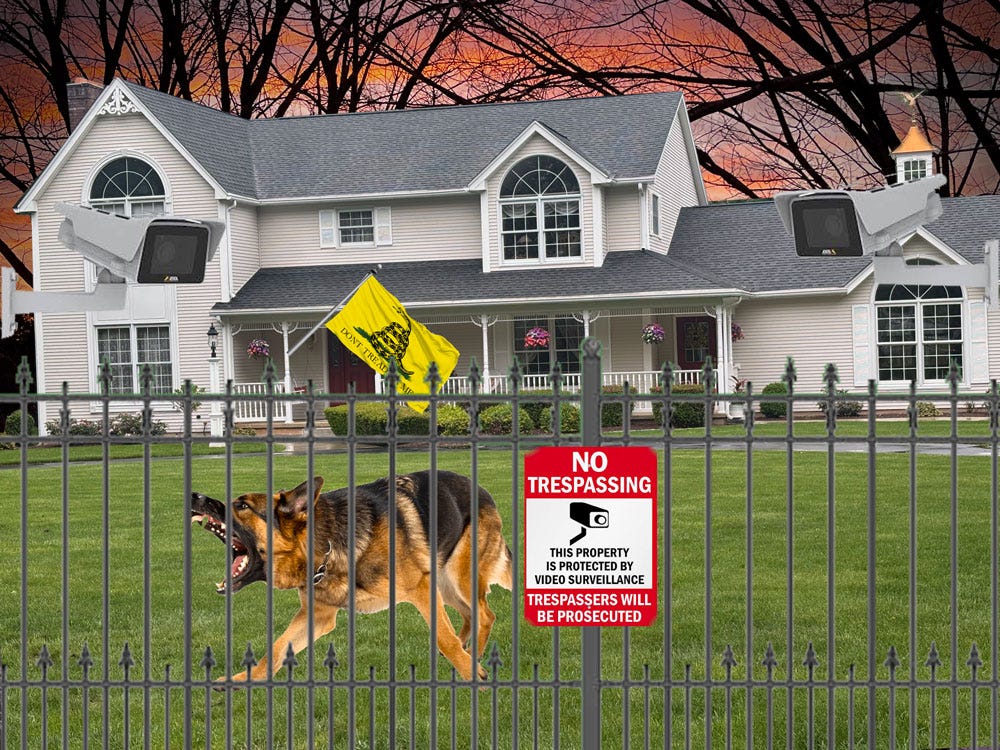
The error in my thinking was believing that if I purchased a backup battery, it should be mine and nobody else’s. This is a very capitalist notion. I paid, so it’s mine. Period.
But why couldn’t I see this backup power as a community asset instead?
If I was fortunate enough to have power when others didn’t, maybe my house could be a refuge and not a fortress. I could cook for my neighbors, allow them to come inside and warm up, or have a safe place to charge their phones.
I’ve written about this before, how it bothers me that we each are required to own a garage full of drill bits or tall ladders or lawn mowers, when a collective model of ownership might make more sense for certain purchases.
The execution of that idea could be a simple schedule (I get the lawn mower every Monday), a tool library of some kind, or something else entirely that I can’t even imagine because capitalism is the only model I have.
Despite my desire for us to all get along, my fears of violence are well founded and supported by historical data and current events. The U.S. military has been trying to overthrow governments in Iran and Venezuela, perhaps with some pretense, but presumably at least partially because the U.S. feels entitled to those countries’ oil reserves and has the military might to take it by force.
The genocide in Gaza over the last three years was done “in retaliation for October 7” but really seems to be about displacing and murdering people who are in the way of Israeli plans to develop waterfront property.
The founding of America 250 years ago was also about stealing land from the people living on it.
Is that tendency to rely on violence and force to take something considered desirable just called being human? Does it need to be that way?
In the end, I decided not to get solar batteries for now and also to not buy a gun, probably ever. I’m hoping for a world where thinking of one need not conjure thoughts of the other.
Thanks for reading Willoughby Hills! Subscribe for free to receive new posts and support my work.
Related Reading
Kindness Will Save Us from The Twilight Zone
I Didn’t See the Aurora Borealis
If you’ve missed past issues of this newsletter, they are available to read here.