

Iranian Saffron
Not everything is what it seems

Welcome to another edition of Willoughby Hills!
This newsletter explores topics like history, culture, work, urbanism, transportation, travel, agriculture, self-sufficiency, and more.
A few weeks ago, one of my uncles unexpectedly passed away at age 65.
I should feel sadness or melancholy or one of the other symptoms generally associated with grief, but I really don’t. For as long as I can remember, he was a sick man that never really got the help he needed. He did not have contact with anybody in my family for at least a decade before he died. I last saw him in person in 2012.
I was never exactly clear on his diagnosis, but my uncle had suffered a workplace injury when he was younger and was on heavy pain medication for most of his adult life. I’m not sure whether the pain meds caused him to present differently than he otherwise would have or if there were underlying psychiatric conditions that would have come out even without the drugs, but he certainly appeared as somebody with severe bipolar disorder.
At one time, he had a seemingly normal life. He had a typical white suburban childhood in the 1960s and 1970s. He was in the marching band and delivered newspapers door to door. As a child, I was often compared to him by neighbors.
My uncle later got married, had a son about my age, and a daughter about six years younger than me. We didn’t see his family often, but when we did, my childhood memories of time spent playing with my cousins were always happy.
When I was in middle school, my uncle suddenly became a very big presence in my life. His marriage had ended and he moved in with my grandparents, his parents, who lived six houses away from us.
The first months after he arrived were a strange time. He was on the “low” side of the bipolar spectrum and was suffering from crippling depression. He slept most of the day, seemingly for hours at a time. My sister and I had to be conscious of making too much noise when we visited for fear that we would disturb him.
Those months of rest were punctuated by long, scary periods of unrest. He was awake for days on end, spoke a mile a minute, and was always plotting something. Even though he only held a high school diploma, he would study law books and plan a lawsuit against the company where he had hurt his back a decade or so earlier. He was a towering figure, probably 6’3” or so, which combined with his demeanor, made him feel even more threatening. When he was on a high, it was best to avoid him if at all possible.
This up and down cycle continued for much of my teen years. As I grew up, I learned from older family members that nearly everybody viewed at least some of my uncle’s problems as a manifestation of his failed marriage and his ex-wife’s personality. She was often demonized within the family and seen as the problem. I took that account at face value, as I only remembered meeting my ex-aunt a few times and didn’t know much about her beyond the stories that largely predated my consciousness.
I moved away from Ohio in 2002 and was far from my uncle’s antics. At some point, he left my grandparent’s house and moved into a nearby apartment, though he was still a strong presence in their lives. Sometimes he was there when I visited, others I would go years without seeing him.

I haven’t given him too much thought in a long time, but have found that his recent death has me reexamining some of the details of his story that I have taken for granted.
After his death, I reached out to my uncle’s two children, my cousins. I had not seen or spoken to his daughter for close to 30 years- she was a kindergartener the last time we had any contact. I was able to get her phone number through a family member and we reconnected.
We ended up speaking by text for a long time, then continuing with a Zoom call. We both remembered a lot about each other and had some shared memories of our grandparents, even though that whole side of the family was not in my cousin’s life after her parents separated.
We talked a bit about her father and the strangeness around his death. My cousin was about seven when her parents divorced and she could only recall one really pleasant memory of her father. She spent her childhood with her mother, with whom she is still very close, and shared with me details of her life that I had not been aware of.
My uncle wasn’t just a scary presence, but I learned he was a violent and abusive person at home. My cousin says he never harmed her, but she remembers seeing her dad beat her mom and her older brother and hiding from him under tables. The abuse continued even after he left the house, as he continued to stalk his family for another decade or so after he was divorced.
My cousin painted an alternate picture of my ex-aunt too, my uncle’s ex-wife. She was not the maniac that I was always told about as a child and teen, but was the victim of verbal and physical abuse, some which caused lasting mobility and cognitive challenges. My cousin, even as a young teenager, had to take on the role of caregiver, one which she has yet to relinquish.
My cousin acknowledges that her older brother remembers their childhood differently and that he has estranged himself from his mother because she was also abusive towards him.
That characterization helps back up some of what I heard as a child, but realizing the reality that my ex-aunt was also a victim of severe abuse alters the stories of my childhood. She is no longer the cartoonish Disney villain, but is a complex person who both sinned and was sinned upon. It’s been a fascinating journey to rethink my past assumptions and have to forge some version of my own truth from these competing narratives.
While I have been deconstructing my thoughts around my deceased uncle and his ex-wife, I can’t ignore that the United States and Israel have been trying to start World War III in Iran.
Like with my ex-aunt, I was always raised by teachers, the media, and our politicians to believe that there were countries that were the sworn enemies of the U.S. no matter the reality: Iran, North Korea, Cuba, Palestine.
But one day, that perception changed, especially around Iran.
Last year around this time, my family and I had a 24 hour layover that allowed us time to explore Istanbul. Turkey in general and Istanbul in particular sit at a strange crossroads. The old city of Istanbul dates back hundreds of years and sits on what is considered the European continent. The city is divided by the Bosphorus Straight, with the suburbs of Istanbul across the water considered to be part of Asia.
Turkey is a majority Muslim country, but it has been home to Christian and Jewish populations over the centuries too. The Hagia Sophia, one of the most famous mosques in Istanbul (maybe in the world) was built atop a Christian church that dated to the Roman Empire. Different people with different stories all called Istanbul home and built upon what had come before.
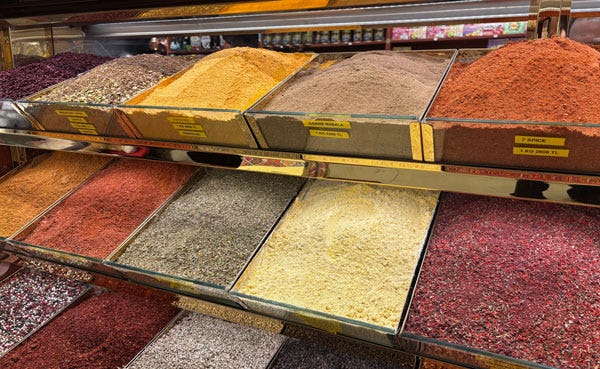
As we were wandering the markets of Istanbul, I was struck by the massive piles of spices sold in bulk, probably still displayed in much the way they would have been centuries ago when exotic tastes and smells from China and India were brought on ships and traded into the European market.
In one stall, I noticed a beautiful display of saffron. Most of it originated in Turkey, but there was also a shelf with more expensive saffron labelled as “Top Quality Iranian Saffron.”
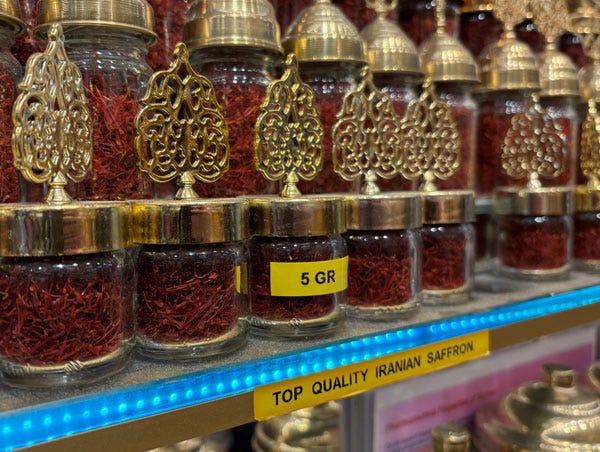
In the United States, anything Iranian is looked at with suspicion, fear, and judgement. But here in Istanbul, a product from Iran seemed to be valued, coveted, premium. Something from Iran being sold in Turkey seemed no different than encountering a Mexican avocado or Columbian coffee in the United States. Labeling it as Iranian is objective truth, more than subjective judgment.
Still, something inside me felt wrong, almost visceral seeing that saffron. It’s like seeing the travel posters to Cuba in Canada, where a vacation to Havana is no different than going to the Bahamas or Bermuda, yet it still goes against everything you’ve been taught to believe.
Over time, it’s becoming more clear to me that perhaps the version of the world that I had been taught was not as binary as the adults said it was. Maybe there was no “good” side and “bad” side, maybe there were just complicated sides.
As I’ve thought about my uncle and his ex-wife, my mind keeps going back to that Iranian saffron. Maybe something that we were taught to fear or dislike isn’t what we figured. Or maybe something can be seen as problematic for some of us but normal to others. My cousin seems to view her mother in the same way that Turkish shoppers view saffron from Iran. My view is quite different.
I am not fully ready to accept the narrative that my ex-aunt was solely a victim, but hearing a different side of the story I thought I had known for so long certainly changed how I thought about her and about my late uncle.
I think it’s the same with Iran, and some of the other places we were taught to fear. They may not be perfect places, but they are more nuanced than the caricatures that American propaganda portrays. Furthermore, like viewing my uncle’s life more critically, perhaps it’s time to acknowledge that America is the abuser and aggressor more often than not. We wrap ourselves in propaganda and patriotic imagery to make us believe that the wrong we are committing worldwide is okay, part of some manifest destiny or world police role. But that portrayal doesn’t really hold up to scrutiny.
I like to think more Americans are waking up and becoming aware of this reality. There is at least some data to suggest that is the case.
About two weeks ago, a Pew Research Center survey shows a sizable 60% of Americans disapproving of the U.S. military action in Iran.
A Gallup poll published in February shows that for the first time in the 20+ year history of this poll, more Americans sympathize with Palestinians (41%) more than Israelis (36%). Even more importantly, sympathy for Israel has been continually trending downward since 2020. As Israel continues to be America’s lone partner in this war in Iran, I suspect that downward trend will continue.
What this all tells me is that the propaganda that used to work on Americans no longer has the same hold on us. We are seeing the destruction of civilizations in real time on our phone, while our president says there is no money for daycare or healthcare. All at the moment our taxes are due.
The world is complicated. Relationships are complicated. Family dynamics are complicated. But hopefully with time, space, and maybe really hearing alternate points of view, there’s room to reexamine that which we’ve always been told or that which we’ve always thought was true.
Thanks for reading Willoughby Hills! Subscribe for free to receive new posts and support my work.
Related Reading
Bats Have More Rights than Palestinians
If you’ve missed past issues of this newsletter, they are available to read here.