

Off Grid-ish
The impossibility of getting fully away
Welcome to another edition of Willoughby Hills!
This newsletter explores topics like history, culture, work, urbanism, transportation, travel, agriculture, self-sufficiency, and more.
I spent most of last week as off-grid as possible, chaperoning a hiking trip for my daughter’s seventh grade class in the White Mountains of New Hampshire. It was a rainy week, with nearly 3” falling in a 24 hour span.
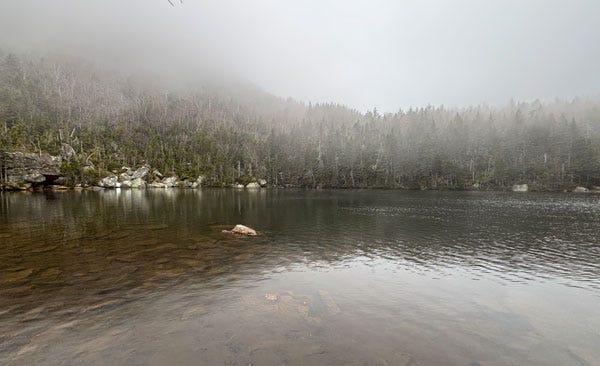
We spent three days and two nights at Carter Notch Hut, which sits at 3,288 feet of elevation in a notch between the peaks of Wildcat Mountain and Carter Dome. The hike to the hut is 3.8 miles from the trail head with 2,000 feet of elevation gain. On the way up, it was a rocky affair, but on the way down, we were literally hiking through waterfalls, with the trail largely mud.
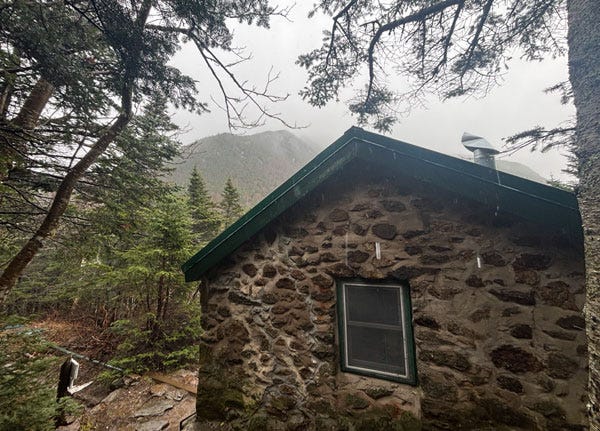
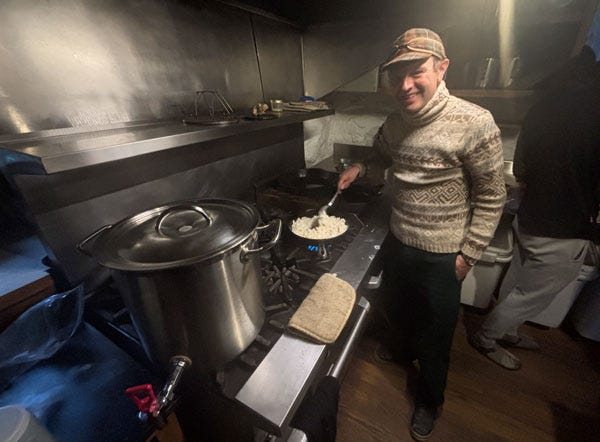
The Appalachian Mountain Club (AMC) owns and maintains eight “high mountain huts” that are only accessible by hiking trail. Carter Notch Hut was built in 1914 and it is the oldest AMC hut still standing. The main hut has mortared fieldstone walls with a metal roof. It’s the gathering place, with a wood stove that acts as a source of heat and a way to dry damp gear, a small kitchen, and a handwritten daily weather report.
Away from the main hut, there are two wooden bunkhouses that each accommodate 20 people in four separate, small rooms. The bunkhouses seal off from the weather, but they are unheated and have no electricity. There’s also a small bathroom building with four composting pit toilets and four sinks. There are no showers.
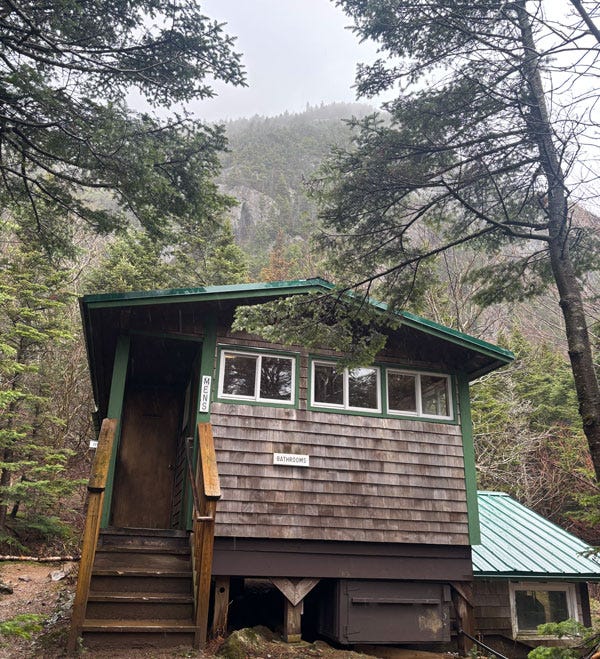
During the summer season, there is a full crew on site that provides bedding and daily hot meals, but during our visit, there was only a single caretaker. The caretaker shift is one week long, during which he sleeps in a bunk on site. He keeps the wood stove hot for about five hours every evening and prepared the daily weather report, but beyond that, our group was on our own for cooking meals, cleaning dishes, hauling out trash, and even providing bedding (in our case, sleeping bags).
The accommodations were warmer and dryer than sleeping in a tent, but they were still quite primitive. And yet, they weren’t.
Since the beginning, the Appalachian Mountain Club huts have been navigating the line between an authentic, rustic wilderness experience and meeting the tastes and needs of modern travelers. According to Miles Howard, a former AMC “croo” member writing for The Boston Globe:
In 1888, the AMC began managing bare-bones mountain shelters — little more than a damp floor, stone walls, and a wooden door — but the list of amenities grew as hikers embraced the dwellings, starting with a wood stove here, then a few cots there. Then, in the 1930s, the AMC reimagined the huts as cozier lodging destinations.
It was during this evolutionary era when family-style meals, bunk rooms with mattresses and blankets, and live-in staff members became pillars of the huts experience.
The Carter Notch Hut and surrounding out buildings have changed quite a lot since first built in 1914. While they are still quite off-grid and inaccessible to vehicles, they also show the persistent creep of technology over the last 100+ years.
Perhaps most notable is an outcropping of several large propane tanks near the main hut building. These are delivered once per year via helicopter, 2-3 tanks at a time. The propane powers a large, commercial style gas range and oven in the kitchen, plus a tankless water heater used for heating kitchen water, and a small propane heater in the caretaker’s bunk.
At one time, propane also provided some overhead lighting in the main hut, although that system was replaced with a solar photovoltaic array with battery storage. A large number of panels are installed on the southern roof of the main hut, out of sight from visitors most of the time. They feed into a large battery bank, which is installed under a bunk in the caretaker’s room (our caretaker jokingly referred to that particular bed as the “cancer bunk” because of the batteries and its close proximity to the wall-mounted solar inverters.)
The solar panels and batteries provide overhead lighting in the main hut, plus lighting in the bathroom. They also power a small fan that’s a part of the composting toilet system.
There was a large commercial refrigerator in the kitchen. I assume that was propane powered as it would draw quite a lot of electricity from the batteries otherwise. But whatever the power source, there was the ability to keep perishable food cold.
In the dead of winter, drinking water is fetched in buckets from a nearby pond, then boiled and treated to make it potable. For our visit, the drinking water well had just been powered up for the season. While drilling a well usually involves a giant rig on a large truck, our caretaker told us that the well at Carter Notch was drilled horizontally into the mountainous stone using a more portable rig (presumably something like a gas auger).
The well water was plumbed to four cold water only sinks in the bathrooms, a water bottle refill station in the main hut (the kind you might see in an airport), plus a commercial dishwashing sink and handwashing sink in the kitchen that also had hot water from the propane tankless water heater.
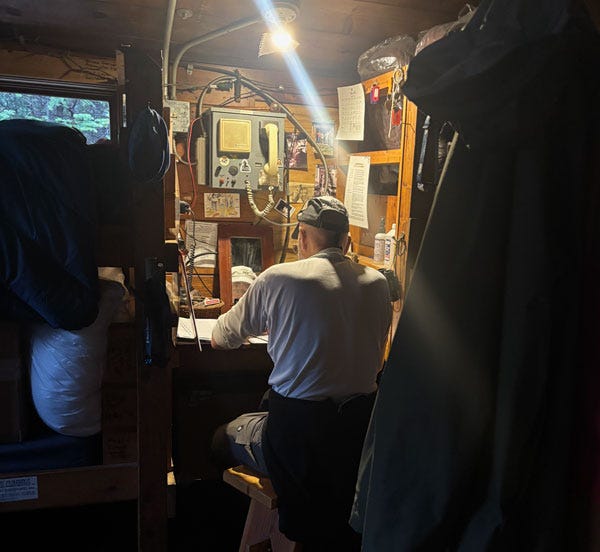
When the caretaker gave us a brief tour of his sleeping quarters, we also noticed a WiFi router mounted near the solar inverters. He explained that this was for the Starlink satellite internet service that had been added fairly recently and was not without controversy. It was provided as a way for caretakers to take cashless payments during the summer season for items in the small gift shop, which featured a small assortment of candy and snacks plus a few hiking necessities like water bottles and hiking poles. As of now, there is not guest access to the WiFi available.
There is also no cell service around the lodge, so there’s not much connection with the outside world. My newer iPhone has an option to send text messages via satellite, but it’s limited to 500 character messages and no photos. I was able to use this functionality to send updates to my wife back home, but they read more like telegrams from the nineteenth century than modern texts.
There are no outlets available for guest use, so charging cell phones is not an option. I brought a USB adapter for a Dewalt power tool battery, which allowed me to juice up my phone as needed.
As I mentioned, the bunk houses have no heat or electricity. This means a cold night, but it also means no lighting of any kind (aside from a small, battery powered reading light at each bunk which provides mild illumination).
When I struggled to stay warm and fall asleep, I kept considering my own privilege that I was able to sleep in a warm bed most nights. I imagined the people sleeping on the cold streets of Boston every night, some whose faces are known to me because I have been passing them for years when I commute into the city. I thought of the refugees and displaced people in Gaza and elsewhere, also shivering but under leaky tarps rather than a framed wooden roof and four walls. And I thought of the poor people in shantytowns around the world whose daily reality looked like this.
And yet, I also considered how technology had already crept into these remote mountain huts and how it might continue to in years to come.
At one time, the wood stove would have been the source of light, heating, and cooking. Pond water and dim lights was acceptable.
Add a bit of technology though and it quickly becomes an “if you give a mouse a cookie” scenario.
A propane stove makes for easy cooking, but then dishes need washing. Why not add a well? But if you now have running water, shouldn’t there also be hot water? And if we’re cooking, shouldn’t there be a refrigerator to keep food cold? And what about lights? You can’t just have lights in the lodge- they should be in the bathroom too. Also maybe Starlink internet. Because how else can you accept ApplePay?
At the moment, there’s not an efficient way to add heating to the bunkhouses without significantly increasing solar production and storage capacity. But adding some simple lights or even a few USB outlets for charging phones, cameras, and backcountry GPS devices seems possible and maybe even imminent. That technology exists for RVs now and only costs a few thousand dollars.
It’s not long before the rustic experience becomes a bit more civilized.
What’s lost and what’s gained with those changes?
According to that same Boston Globe article I cited earlier, AMC has struggled financially post-pandemic. While COVID helped bring more people into nature, it also saw the rise of glamping.
The AMC huts are located within the White Mountains National Forest, but just beyond the park’s boundaries are a smattering of lodging options at all price points and levels of comfort, from the family friendly Jellystone Park where one can pitch a tent or sleep in a popup camper to the ultra posh Omni Mount Washington Hotel where room service can deliver breakfast in bed as Mount Washington looms in the distance.
While the AMC huts provide a quiet reprieve at the end of a hike, they are not the only option travelers have to explore the White Mountains. That very real capitalistic pressure is likely part of what introduced the slow parade of amenities over the decades, and what will continue to allow for improvements.
There’s an interesting corollary here with lots of other types of technology too, and the question of where we draw the line. For many years, I was an Apple gear head and was always looking to “optimize” my Apple experience (which really just meant spending more money). I already had the phone, so why not add in the Apple Watch and the AirPods? Of course, then everything needs upgrading every two years or so, so instead of just buying a new phone, I’m buying several new items with frequency. I ditched the Watch and AirPods years ago, but am still beholden to the iPhone.
I’ve written before about the rising price of new cars too, and some of that can be attributed to this technology creep. New cars are built with safety and comfort features, some of which are mandated by law and others driven by consumer demand: adaptive cruise control, lane departure systems, CarPlay integration, heated and cooled seats, heated and cooled steering wheels, the list goes on and on. While safety systems can help prevent an accident, they are also no substitute for attentive and cautious driving.
Perhaps this question of the technology creep line is most pronounced in the Amish community. As I’ve described here previously, each local church sets the rules for its congregation. While some are still quite conservative, many do allow for the use of phones, computers, and even smart phones for the purposes of conducting business.
An Amish farm we frequent in the Lancaster, PA area sells local dairy products in a self-serve shed, where a QR code is posted to send Venmo as payment. At an Amish grocery store that I’ve toured in this newsletter, power tool battery adapters are sold so that electric appliances can be used without plugging directly into an electrical outlet.
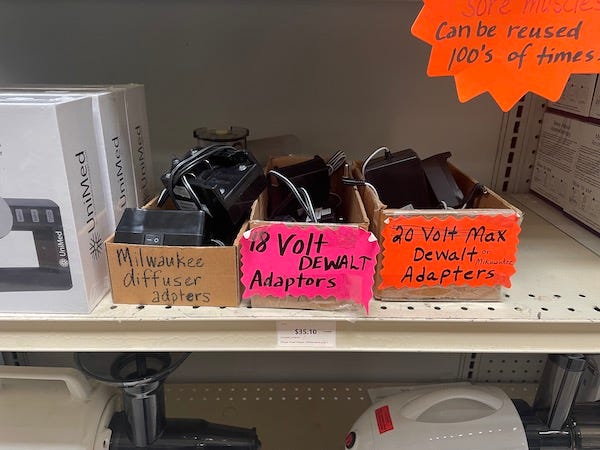
If the Amish are wrestling with the question of technology incursion and are coming out on the side of the smart phone, what hope does a primitive hut in the White Mountains have of surviving in its purest form?
Because there is a beauty to the primitive nature of things. On a rainy day, the main hut became a place to gather and get warm. Without the distraction of WiFi or even the easy ability to charge phones, students and adults alike were forced to be deeply present with one another.
For the adults, this meant engaging in conversation with one another. Some of these discussions were shallow catching ups about trail conditions, while others were prolonged explorations on the meaning of life and purpose. For the kids, card games abounded until a chin up bar was discovered, at which point students competed for most pull ups or longest dead hang.
My son is four years behind my daughter in school. I wonder if his class were to take the same field trip and were to chaperone it in four years, how differently might this mountain retreat look then?
I like to hope that someday soon I can return to that same primitive camp again, but I also wouldn’t be surprised if there are lights, heat, full WiFi across the facility, and maybe even rain head showers.
Because the world keeps moving forward. Always. But sometimes it’s nice to stop and question if we are making progress or simply “progress.” Real progress to me feels more like those wood stove conversations about the meaning of life than about the latest meme somebody posted online.
Thanks for reading Willoughby Hills! Subscribe for free to receive new posts and support my work.
Related Reading
If you’ve missed past issues of this newsletter, they are available to read here.
Sounds like a wonderful experience for the kids. Together as a group, surviving rain, mud, cold nights, lack of cell service and wifi, hiking a mountain with a backpack, camp food...Perfect. Good job, Heath!
I went to an AMC hut once with my youngest daughter. Cold. Wet. She might have been 12, too. I realize now that it was the very first of a number of trips into nature or downright wilderness we have subsequently taken. We are bonded on those experiences, for sure. Happy memories. Thanks!