

Original Sin
How the Book of Genesis informs modern conservatism

Welcome to another edition of Willoughby Hills!
This newsletter explores topics like history, culture, work, urbanism, transportation, travel, agriculture, self-sufficiency, and more.
Substack recently suggested an article to me written by Ben Wheeler titled “Liberals Don't Understand Conservatives & It's Why They Can't Fight Back.”
The article gets at a central tension that I’ve felt as somebody on the left of the political spectrum over the Trump years: how can people who identify as conservative continue to support the current president when he seems so antithetical to their supposed belief system?
It’s the question of how a thrice married, serial adulterer, sexual predator has come to represent “family values” to Evangelical Christians. How the party of “small government” is in favor of ever expanding war budgets. How somebody who seems to only serve the millionaire and billionaire class is supported by white, blue collar workers with barely a net worth in rural America, the Rust Belt, and places like Long Island.
To be clear, this is not a comparison of Republicans and Democrats, as I believe there is increasing similarity between how elected officials of both parties behave. (Sarah Kendzior referred to them as the “uniparty” in a recent piece). Instead, this is about how regular people along the political spectrum understand their world.
Wheeler sets up the tension of the liberal view of conservatism with the mantras of “Don’t Tread on Me” and “Back the Blue,” which on their surface seem contradictory:
“It is true that police are members of our communities and families, but they are also agents of the state. The police enforce the laws and orders of the government, and they are - more than any other part of government - the most likely to tread on you. So how can it be that conservatives can believe both of these and not feel embarrassed by the contradiction? How can conservatives believe in law and order while also supporting a President who is objectively the biggest crook to ever reach the White House?”
In Wheeler’s view, the liberal understanding of this country is one rooted in the actual text of the Declaration of Independence, if not the implicit bias or contradictions of its author or how it has been applied over the last 250 years. Many of the political left believe, or want to believe, “that all men are created equal, that they are endowed by their Creator with certain unalienable Rights, that among these are Life, Liberty and the pursuit of Happiness.”
Throughout American history, those words have not proven true of course. Indigenous Americans were murdered through systemic genocide for centuries. African people were captured, sold into slavery, and exploited, an exploitation that continues today. Asian Americans were excluded from immigration, and then later, rounded up in internment camps. Women, even white women, weren’t allowed to own property or vote for most of American history.
Still, for many on the left, that notion of equality is still the lens through which they view the world, as dirty or cracked as those lenses may be.
Growing up, this was true for me. My elementary school teachers in the 1990s seemed to emphasize struggles like the Civil War and the Civil Rights Movement, championing the perspectives of folks like Dr. Martin Luther King and Rosa Parks. I understood that the world wasn’t perfect, but believed that "the arc of the moral universe is long, but it bends toward justice.”
As an adult, this perspective has been tested a lot: watching the water crisis in Flint, the exploitation and enslavement of Uyghurs in China, the genocide of Palestinians. I have seen all of these as wrong because I believe in my deepest heart that we are all human, that the random circumstance of our birth should not affect our right to live our fullest life, and that we should generally approach each other with the idea of “do no harm.”
In Wheeler’s assessment, modern American conservatism does not view the world through this lens (emphasis added):
“Frank Wilhoit wrote that the backbone of conservatism is that ‘there must be in-groups the law protects but does not bind, and out-groups the law binds but does not protect’. Why must there be in-groups and out-groups in the conservative view though? Conservatism at its core is about believing in a strict hierarchical society. Corey Robin wrote in The Reactionary Mind that conservatism across two centuries is fundamentally the defense of established hierarchy against threats from below. Rather than a philosophy of liberty or tradition, the right is actually a reactionary movement defending power, privilege, and inequality.”
Wheeler goes on to say (this is a long excerpt, but it’s an important one):
“America’s conservatives and their ideology are descended from Robert Filmer’s Patriarcha or The Natural Power of Kings from 1680. Filmer says that human society is not a collection of equal individuals bound by a social contract, but a divinely ordained, rigid hierarchy where some are born to rule and others are born to serve. In this framework, the state is an extension of the patriarchal family: the leader holds absolute, unquestionable authority, and subjects owe total obedience. I am not making the claim that your average MAGA voter has read 17th-century political theory, but rather that Filmer’s ideas have mutated into a potent blend of cultural populism and Christian Nationalism.
While Donald Trump uses anti-establishment rhetoric to attack a perceived ‘technocratic and progressive elite’ hierarchy, his base supports him because they believe he is tearing down a false hierarchy to restore the natural one: one where white, Christian, traditional family structures sit at the top.
Trump is willing to meet their demand to stop elevating the ‘out-group’ above the ‘in-group.’ When a conservative demands ‘Law and Order,’ they are not calling for an impartial application of the rule of law to all citizens equally; they are calling for the enforcement of this social hierarchy.
The Filmerian philosophy completely resolves the apparent contradiction between ‘Don’t Tread On Me’ and ‘Back the Blue.’ To them, the ‘Me’ in the ‘Don’t Tread On Me’ phrase represents the divinely or naturally ordained in-group - those who, by virtue of their position in the hierarchy, are entitled to total liberty and protection from the state. In this worldview, liberty itself is an asymmetrical concept. To a liberal, liberty is a universal right that must be shared equally to exist. To the hierarchical conservative, liberty is a privilege of status. If everyone possesses it equally, it loses its value.”
Basically white supremacy.
Straight, cis, able-bodied white men are at the top of this hierarchy, which they view as divinely ordained, and everybody else falls somewhere below them on a decreasing scale.
I read Wheeler’s piece a few days ago and kept thinking about it. It’s a framing of the modern conservative movement that I should have consciously considered much sooner, but admittedly had not, or at least not in the way he laid it out.
The more that I thought about his argument, the more that I realized why it sounded so familiar: it was also the central tension that I felt as a young Catholic child learning about the Book of Genesis.
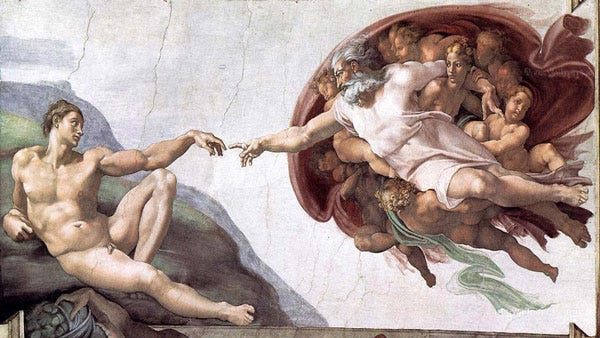
In my Catholic upbringing, the God of the Bible was spiteful, vindictive, and petty, and right from the get go. Within a few paragraphs of the Book of Genesis, it’s clear that God is selective about how he shares his love.
I’m not a Biblical scholar, but these are some of the stories that I remember from my youth.
God created everything, including a man and woman. He gave them only one rule: don’t eat from that tree.
Eve cannot resist the temptation, and tried the forbidden fruit. For this, she and Adam are banished from Eden and forced to toil for the rest of their days. Not only does God punish Eve (and Adam) for her choice, but in Catholicism, he punishes all of humanity for eternity. We are all born bearing the “original sin” of Eve, which can only be cleansed through Baptism in the church.
This same God who punished Eve with no hope for reconciliation for her or any future human supposedly would be forgiving of our transgressions.
Eve was a sinner, but I was okay somehow. Or that was the message I was hearing. It didn’t add up to me.
This was further complicated by how some of my Evangelical friends viewed God. Many of them spoke about an intimate relationship with either God or Jesus (which as Catholics, we believed to be one in the same, so I didn’t pay close attention to the distinction).
They would pray to God for help on a test. They would talk to him about the minutiae of their dating life or their problems with their parents. They acted like God/Jesus was a fellow classmate, somebody who was very invested in who they chose as their prom date, rather than some kind of supreme being that was responsible for creating literally everything.
This notion of “God as BFF” became the beginnings of my deconstruction of the faith I was raised in, even if I wasn’t fully aware of it at the time, because it seemed to directly contradict with so much of the picture that I had of God.
And that picture of God choosing in and out groups didn’t end with Eden.
Some time after Adam and Eve, God senses that people are getting wicked and wants to start over. The only people he sees as worth saving are Noah and his family, so he instructs Noah to build an ark and board a handful of animals and his immediate family.
Noah and his kin are worth redemption. Literally every other human and most other animals perish in a flood.
God loves Noah. God hates bad people.
The “other people” that died in the great flood are essentially Storm Troopers from the Star Wars movies: a group that have vaguely human form but are seen as disposable and non-individual. They are there to serve the story, but have no real humanity. Who would sympathize with a Storm Trooper?
Like the endless Star Wars spin offs and sequels, these stories are repeated over and over again with the stories of the Tower of Babel, God’s request that Abraham murder his own son until he lets him know it was just an early episode of Punk’d, Moses drowning hundreds of Egyptians in the Red Sea, and on and on.
God cares about my life, but not all lives, basically.
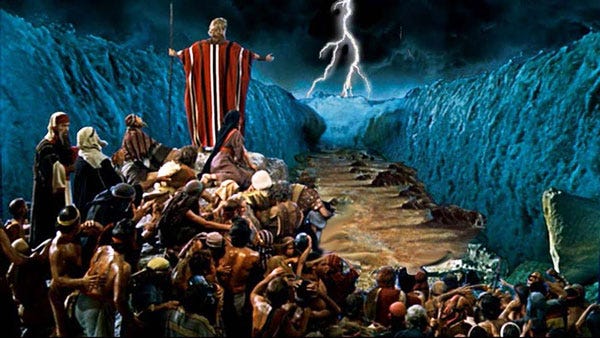
Those “Storm Troopers” appear again and again in our modern politics and media: Palestinians, “illegal” immigrants, welfare recipients, pretty much anyone that’s identified as a group worthy of derision, rather than seen as unique individuals.
The more I thought about it, the more I realized that the Book of Genesis is fundamental for understanding the dynamic that Wheeler describes about conservatives. Genesis is also the foundation for the Bible and the starting point of Judaism, Islam, and Christianity. So its influences run deep.
Conservatives see themselves as Noah. They identify with the notion that there’s an “in group” (white Christian men) whom God loves and favors and an “out group” (people of color, LGBT+ people, disabled people, women, etc) who deserve scorn as a consequence of their birth. The in group gets a ticket to the ark. The out group drowns in the flood. Because that’s the supposed natural order.
It’s totally okay, in their worldview, to strip the out group of wealth, rights, or even life, because they weren’t even fully human to begin with. They were Storm Troopers.
This is distressing for me to consider as somebody who believes the logic that if God created me to be great, then surely he did the same for everybody. That’s the only way that I can see the world because I literally cannot imagine another possibility. Why would God make me a main character and treat everyone else as background actors? It doesn’t add up.
And it’s probably why I struggled so mightily to identify as Catholic until I got to the point that I could no longer hold that title.
I think Wheeler has it right. What many of us on the left view as a contradiction is actually a central part of conservative identity. To Wheeler, it originates in the 1600s and continues to today. I would argue that it goes back even further, to the Bible itself.
I highly recommend reading Wheeler’s whole piece and hearing your comments below!
Thanks for reading Willoughby Hills! Subscribe for free to receive new posts and support my work.
Related Reading
I Won’t Tell You to Avoid McDonald’s
If you’ve missed past issues of this newsletter, they are available to read here.
I think you’re onto something, but I’d take it one step further. The deeper issue isn’t simply hypocrisy—it’s that many people don’t begin with equality as the moral baseline. If hierarchy is assumed to be natural or divinely ordained, then liberty and justice become privileges reserved for the “right” people rather than universal principles. What looks like contradiction from the outside is often a coherent worldview built on different first principles.
Thank you for reading & I really appreciated your thoughts. I think you’re completely right, as a fellow lapsed Catholic and Catholic school kid.