

Button Cell Blues
Nothing works like it should and repairs are impossible

Welcome to another edition of Willoughby Hills!
This newsletter explores topics like history, culture, work, urbanism, transportation, travel, agriculture, self-sufficiency, and more.
I like to think I’m a simple man. I believe that things should work as intended, and if they don’t, I believe they should be relatively easy to repair.
Simple ideas, right?
And yet, these basic assumptions no longer hold true in today’s economy.
I’ve written about the problems with large appliances like refrigerators that seem designed to fail after only a few years, but today’s example is much smaller: a simple thermometer.
Over the years, we’ve accumulated a small arsenal of digital, oral thermometers, as one does when they have children. We only ever really needed one, but then a kid would feel feverish on vacation and we’d buy one for that emergency. After a few years of patterns like this, we had three or four stashed in various drawers and travel bags.
As my kids have gotten older (they’re 12 and 9 now), we’ve reached for thermometers less and less, although they’re still helpful when somebody isn’t feeling well and we’re not sure if we should let it run its course, administer medicine, or call the doctor.
Our thermometers resurfaced over the holidays, when both of my kids were hit with the flu that’s currently surging around the U.S. (I ended up contracting it later too, but my wife has somehow avoided infection thus far).
We located two thermometers on Christmas Eve when my daughter first started showing symptoms, but neither one would power up. Probably just dead batteries I assumed. Since most stores sell the little button cell batteries that go in modern thermometers, I didn’t see much of an issue. I took the batteries out of both thermometers and headed to The Home Depot.
Here’s where things started to get tricky. There are several types of button cell batteries, way more than I had ever realized. When I’ve had to purchase replacement button cells in the past, say for my car’s key fob, it’s been relatively straightforward. There’s a number printed on the battery, I find that battery on the shelf, easy peasy.
But in this case, neither number on the batteries from my thermometers matched any batteries on the shelf. The Home Depot has a display with life-size printouts of various batteries, which allowed me to hold what I had up to match the diameter of the battery. It was fairly easy to find a similar sized battery that way, but when I compared what I had in my hand to what the display suggested I purchase, they didn’t look exactly like a match.
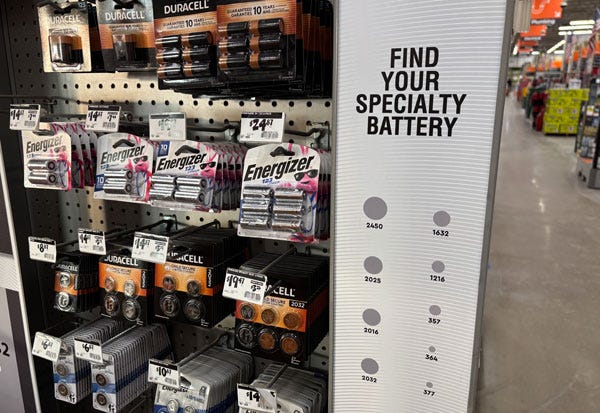
It turns out that button cell batteries vary in both diameter and thickness. Even though my battery matched a diameter on the display, mine was thicker than what they were selling. A Google search on my phone confirmed that the battery I had and the battery the display said that I was supposed to purchase were not a match.
I was able to find what looked like the correct sized battery to replace my other thermometer’s power source using The Home Depot’s chart, but when looking for the actual item to purchase, I found an empty peg on the display. The Home Depot would not be my solution to this problem.
I decided to stop by CVS to try my luck there. I was kind of excited when I found the battery display because button cell batteries were on sale. But yet again, nothing on the shelf matched the numbers in my hand.
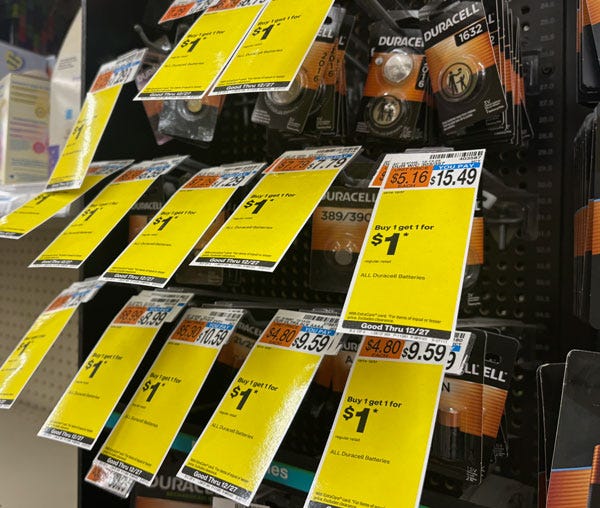
I sat on the nasty CVS carpet, pulled out my phone, and tried to see if Google might hold any clues as to what I needed. It wasn’t long ago that Google was getting flack for summarizing data at the top of their search pages, robbing web pages of the traffic. Those now seem like the good old days.
Have you tried Googling anything even mildly complex these days? Your first answer is an AI generated summary.
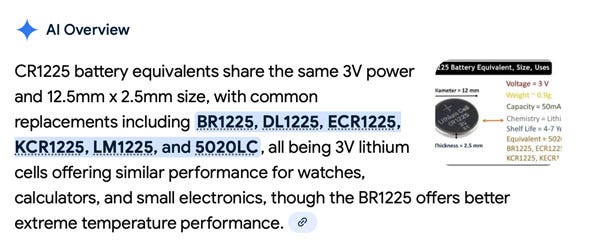
These AI results look accurate, but I have a hard time trusting them or knowing if they’re actually helpful. Plus, I have some ethical concerns with the amount of electricity and water that generative AI uses. I can’t turn off the Google AI results, but I can at least ignore them.
After the AI answer, the top search results in my battery queries seemed to be webpages that didn’t really offer a ton of information but were built more for search engine optimization. In other words, they were webpages filled with content that didn’t say much and took a lot of work to decode, way more than I had time or interest to do on a cellphone seated on the floor of a CVS.
Ultimately, I was able to find one battery that seemed like the right replacement based on my haphazard Google searches. I bought it, returned home, and installed it in my old thermometer. Success!
I checked my kids’ temperatures, administered Tylenol to bring down their fevers, and kept an eye on things.
The next day was Christmas morning. The thermometer that had worked perfectly with a new battery the day before was now on the fritz. It would only power up on occasion. I tried adjusting the battery and that seemed to do the trick, but then it ultimately just fully died. The display looked broken and nothing worked.
Reluctantly, I went to another CVS location on Christmas Day in search of a replacement thermometer. I paid maybe $7 the day before for a new battery. A brand new thermometer was only $10, so I could see why most people probably don’t even go through the effort of trying to swap a battery.
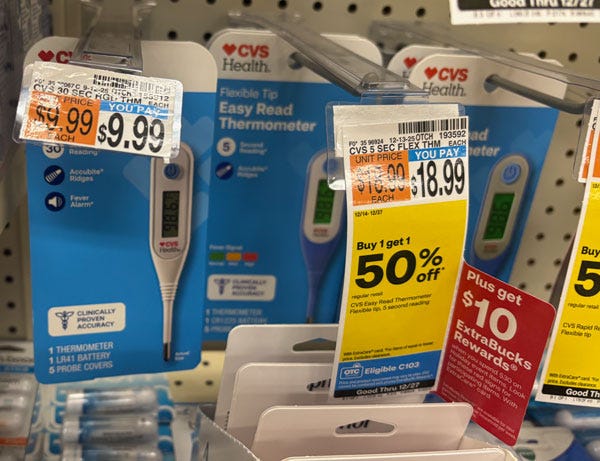
I spent $19 for what seemed like the “nicer” thermometer. I came home and measured my son. 102.3ºF. Just for good measure we checked again. Literally moments later, the new thermometer registered 99.7ºF. It was doubtful that his temperature fluctuated that much in a matter of seconds, so which was accurate?
To test the thermometer, I decided to take my own temperature. I wasn’t yet sick and should have the normal body temperature of 98.6ºF, right? Well, I measured at 95.5ºF, which is close to dangerous hypothermia levels.
The only conclusion that I could draw was that we somehow had a defective thermometer.
This is an increasingly common experience, especially when purchasing items off of Amazon (for those wondering, we haven’t had Prime for more than a year, which is why I didn’t order it off of there). It’s also common on discount importer sites like Temu.
From what I could tell by surveying the thermometers on offer at the grocery store pharmacy, CVS, and Target over the next few days, there is no longer such a thing as a “name brand” thermometer (maybe there never was one to begin with). Nearly every one seems to be sold under a private label, either using a store brand or some other known health care brand that’s not necessarily synonymous with sensors and devices (Target sells a Vick’s brand thermometer for example although I’m not sure that making mentholated rubs qualifies one for manufacturing sensitive electronics).
CVS is a retail pharmacy that’s also both a health and prescription insurance company that also operates many “Minute Clinic” urgent care centers. In other words, if there’s any brand that should be synonymous with “health care,” it’s CVS. And yet, a simple medical device sold under their name can’t even be trusted to be accurate.
This may sound like a minor squabble, but I think it’s important and indicative of a much bigger problem. For those without kids, each degree of a fever brings with it a different course of action. A low grade fever usually just involves monitoring and watching for comfort. As the body gets hotter, a fever suppressant like Tylenol can help prevent dangerous spikes. Above 105ºF they say requires immediate medical attention.
If I don’t know the actual temperature of my child, I don’t know how best to care for them. If the thermometer is reading 102ºF and I keep them home but their actual temperature is closer to 105ºF, I may literally be putting them in danger by not getting them medical attention.
It’s not just my child’s body temperature that I can’t trust though. We are increasingly living in a time where all data is suspect. We can no longer assume that hurricane warnings or other severe weather data is accurate. Vaccines were once a life saving technology, now our government is discouraging some of them, seemingly at the whim of HHS secretary Kennedy more than as a reaction to new data.
As for the companies producing goods that no longer work as they should, we don’t hold them to account as consumers. In the case of private label brands like the store brand thermometers, it’s unclear who we should even complain to. We buy stuff, it immediately breaks, and then what?
Sometimes we might go through the effort or returning a defective item, although those returns seem to be increasingly ending up in salvage shops. Other times, we literally just toss the item and shrug off the small financial loss (Is $10 really worth that much of a fight or an extra trip to the store?)
I’m complaining about what should be a bug in the system, but it’s really a natural distillation of how capitalism is designed to work. Companies have no incentive to sell something high quality, made of durable materials, which is easy to repair. There’s simply no ongoing revenue stream there.
For decades, companies have designed products with planned obsolesce in mind, meaning a good is useful for a time but is ultimately designed to fail someday and require replacement (and thus, a reliable revenue stream for the corporation).
For most of my lifetime, I’ve been aware of planned obsolesce, even if it didn’t affect me greatly. An item that failed after several years didn’t feel like a nuisance. Over time, that obsolesce curve feels like it’s been shortened and shortened, to the point that an item is no longer reliable out of the box. It’s great for the corporations, but awful for consumers and awful for the environment.
The best that I can do in this moment is to call out this waste and to try to seek thoughtful alternatives. There was a part of me that wanted to go on eBay or Marketplace and seek out one of those glass thermometers filled with mercury from my childhood. Sure the glass has the danger of shattering in one of my kid’s mouths and the mercury is toxic if ingested, but at least that style thermometer works reliably, or it does in my memory.
Maybe in that’s a bad example, but there is growing consciousness around the problems with buying new and an appetite for quality items from the past. Ted Gioia published an interesting piece recently on the rise of giving secondhand gifts over the holidays.
I’m fed up with our current system. I don’t like that I can’t trust a basic thermometer to actually work. I don’t like that a dead battery is now a death sentence for a device. And I don’t like wasting time or money on something that’s not built well.
For now, the flu has passed our family and the thermometers are back in their drawers. Hopefully it will be a long time before they’re needed again. I just wish I could count on when they’re needed they will work as designed. But I can’t. Because I live in a capitalist society in 2026.
Thanks for reading Willoughby Hills! Subscribe for free to receive new posts and support my work.
Related Reading
If you’ve missed past issues of this newsletter, they are available to read here.